

Crambe maritima
- noun
- I planted Crambe maritima in my garden last spring.
Examples
-
Gardeners in Britain often cultivate Crambe maritima for its edible leaves and attractive appearance.
-
The young shoots of Crambe maritima are harvested in spring and eaten as a delicacy.
-
Crambe maritima thrives best on well-drained sandy soils along the coastline.
-
Have you ever tried Crambe maritima as a vegetable?
-
The plant known as Crambe maritima is commonly called sea kale, and it grows in northern Europe's coastal regions.
-
For dinner, I prepared a dish using Crambe maritima, which adds a unique flavor to many vegetable recipes.
-
In coastal gardens, Crambe maritima offers both attractive white flowers and nutritious, edible leaves.
Synonyms
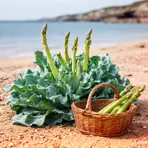
A coastal plant with thick blue-green leaves and edible shoots
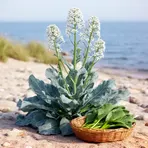
A plant by the sea with large blue green leaves and small white flowers eaten like a vegetable
Surface Forms
Morphology
Crambe + maritima
This is a Latin binomial combining a technical genus name with the epithet 'maritima' (maritime/coastal). A learner who somehow knows both constituents might infer it denotes a coastal Crambe (i.e. a coastal plant), but the specific identity, common name 'sea kale' and its use as a perennial vegetable are specialized and not predictable from the parts for a B1 learner. Because the habitat sense is recoverable but the precise botanical/culinary meaning is not, the expression is only partially transparent.
Etymology
Crambe maritima may come from old words: crambe meant a kind of cabbage and maritima meant 'of the sea'. Because the plant grows on the coast and people ate its leaves, the name is like calling it a 'sea cabbage', which explains the name today.

