
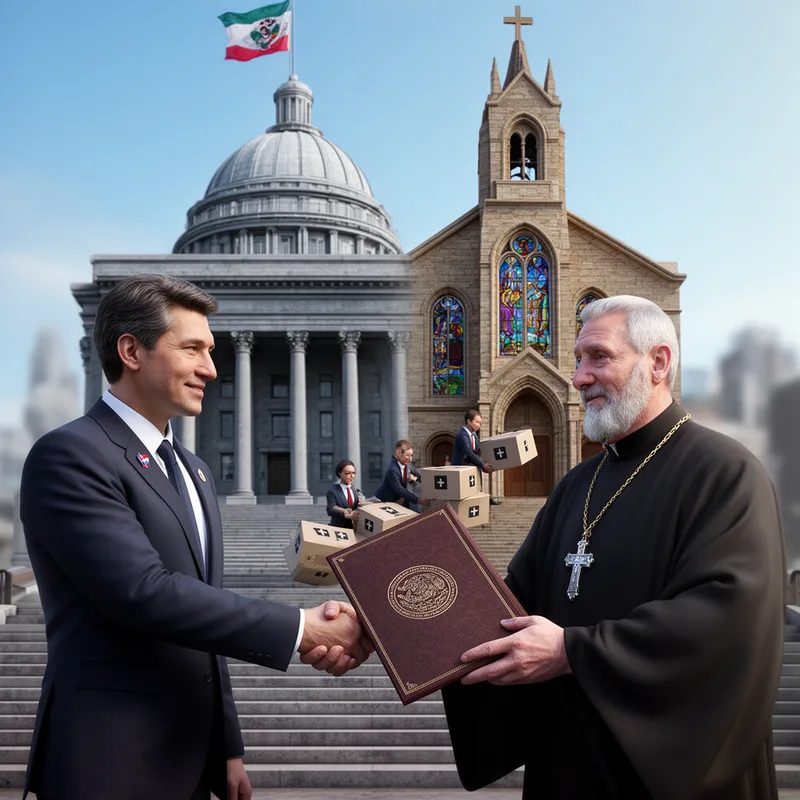
Constantinian
- adjective
- /ˌkɒnstənˈtiːniən/
- Formal
- The dominant theology of the church has, at least since the time of the Constantinian settlement in A.D. 313, been firmly on the side of successive ruling classes, and frequently it has been used to prop up corrupt and oppressive regimes.
- Constantinian church
Examples
-
One of the consequences of the historic Constantinian alliance between church and state has been the emergence of a hierarchy of control in the church similar to that which exists within the state.
Academic text (1990) -
The church has been unmoored and should joyfully take leave of the settledness of Constantinian social arrangements that gave it privilege and power.
Academic text (2008) -
Constantinian Politics and Supersessionist Readings
Academic text (2000) -
So Constantinian polity, if not pretension, has gone the way of Western European Christianity.
Academic text (1994) -
The first, retrenchment, seeks to regain cultural and political power for the church by retrenching to the Constantinian mentality of Christian dominance.
Academic text (2000) -
In the end, the supersessionist hermeneutic of Himes and Himes continues to serve the Constantinian agenda of ingratiating Christianity to the state.
Academic text (2000) -
Radicalization involves a return to the roots of the church's identity—a return that calls into question the Constantinian practices that shaped the church for centuries.
Academic text (2000) -
Yoder labeled the Christian temptation for political power as 'Constantinianism' (for obvious reasons), and argued that even after the separation of church and state, the church continues to fall prey to Constantinian tendencies.
Blog text (17) -
The debate over Constantinian principles continues to influence modern discussions about the relationship between religion and government.
-
Many argue that the Constantinian era set a precedent for how churches could leverage state influence to expand their reach.
Surface Forms
Morphology
Constantinian = Constantine (semi-transparent) = Constantine + ian
Formally derived from 'Constantine' + '-ian', but the political/theological meaning (a model associating church and state) is a generalized, specialized extension rather than a strictly literal relation.
Etymology
Constantinian comes from the emperor's name Constantinus because Constantine used the power of the state to help the Christian church, and his actions set a model of close ties between church and government. So a 'Constantinian' approach today means a policy that 'supports' a close alliance between church and state.

