
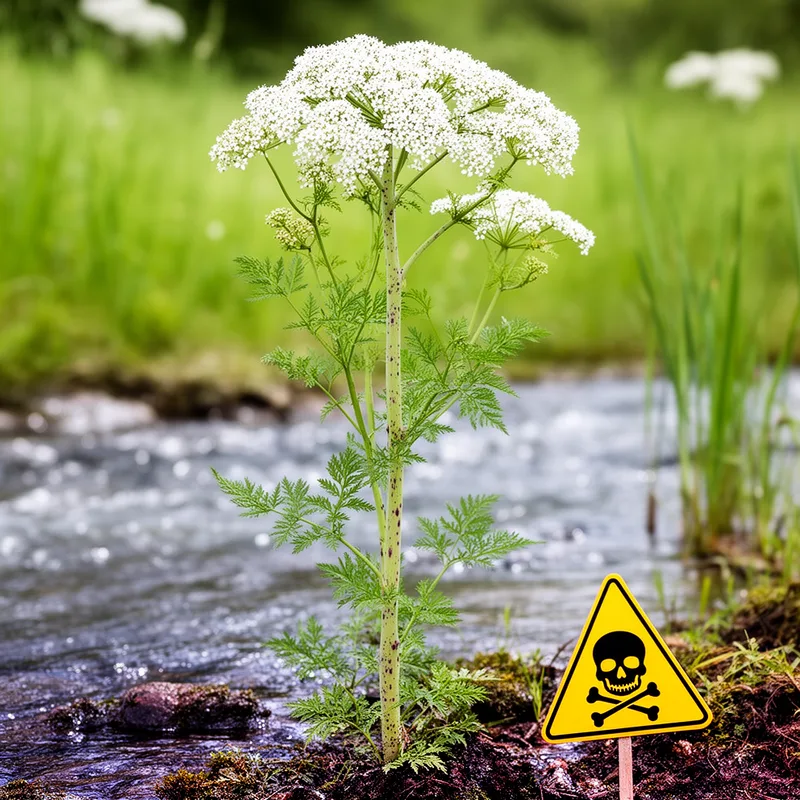
Conium maculatum
- noun
- /koʊˈniːəm mækjʊˈleɪtəm/
- Specialized
- Children should be taught to recognize Conium maculatum because all parts of the plant are dangerously toxic.
Examples
-
The death of Socrates was caused by a concoction containing Conium maculatum.
-
Botanists warn that Conium maculatum can easily be mistaken for harmless wild parsley.
-
The plant Conium maculatum is notorious for its toxicity.
-
Have you ever seen Conium maculatum in the wild?
-
Children should be taught to recognize Conium maculatum because all parts of the plant are dangerously toxic.
-
Botanists warn that Conium maculatum can easily be mistaken for harmless wild parsley.
-
The plant Conium maculatum is notorious for its toxicity.
Synonyms


 1
8.8
1
8.8
A tall poisonous plant with fern-like leaves and clusters of white flowers

A tall very poisonous plant with leaves like a fern and small white flowers
Surface Forms
Morphology
Conium + maculatum
This is a Latin binomial (scientific) name functioning as a proper noun rather than a compositional English phrase; its everyday meaning 'hemlock' is lexicalized and not derivable from ordinary English knowledge. The second element 'maculatum' is not an English word (absent from the dictionary entry) and would require specific botanical/Latin knowledge to interpret, so a B1 learner knowing the constituents would not reliably infer the MWE meaning.
Etymology
Conium maculatum is the formal name for the poisonous plant called 'hemlock'; the name itself paints a picture — Conium refers to the hemlock plant and maculatum means 'spotted'. This helps you remember that Conium maculatum is a toxic herb with a tall stem that often shows dark spots, so the name links the look of the plant to its danger.