

Cleistes divaricata
- proper noun
- Specialized
- The rare Cleistes divaricata blooms each spring in the wetlands of New England.
Examples
-
We spotted a patch of Cleistes divaricata along the shaded trails during our hike.
-
Botanists debated whether Cleistes divaricata should be retained in its genus or moved to Pogonia.
-
Look at the Cleistes divaricata!
-
What a stunning Cleistes divaricata!
-
The rare Cleistes divaricata blooms each spring in the wetlands of New England.
-
We spotted a patch of Cleistes divaricata along the shaded trails during our hike.
-
Botanists debated whether Cleistes divaricata should be retained in its genus or moved to Pogonia.
Synonyms
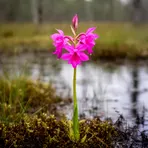
An orchid with bright pink, funnel-shaped flowers that grows in northeastern US wetlands

A North American orchid with pink funnel-shaped flowers that grows in marshes

A wild orchid with funnel-shaped bright pink flowers that grows in the northeastern United States
Surface Forms
Morphology
Cleistes + divaricata
This is a Latin binomial (a species name) rather than a compositional English phrase. Even if a learner knows 'Cleistes' as an orchid genus, the epithet 'divaricata' has no dictionary entry here and the species' descriptive meaning (flower color, shape) is not derivable from the parts, so the overall meaning is not predictable for a B1 learner.
Etymology
Cleistes divaricata may come from ancient Greek and Latin words: Cleistes from a Greek word for 'closed', because the flower can look like a small closed cup, and divaricata from Latin for 'spread', because its petals open outward, so the name describes the plant's shape.

