

Cirsium lanceolatum
- noun
- Specialized
- The prickly leaves of Cirsium lanceolatum make it easily distinguishable from other weeds.
Examples
-
Gardeners often struggle to remove Cirsium lanceolatum due to its deep, spreading roots.
-
Cirsium lanceolatum commonly invades pastures, reducing their value for grazing livestock.
-
The Cirsium lanceolatum is often found in disturbed areas.
-
Many gardeners consider Cirsium lanceolatum a nuisance.
-
Cirsium lanceolatum can rapidly take over gardens and lawns, making it a troublesome weed.
-
Due to its resilience, Cirsium lanceolatum often thrives in poorly managed fields.
-
The sharp thorns of Cirsium lanceolatum deter animals from grazing on it.
Synonyms
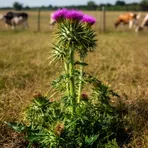
A plant from Europe with large prickly flower heads that grows as a weed

A tall thistle with large flower heads and sharp spines that grows wild as a weed

A prickly plant that has large purple flower heads and grows wild as a weed

A tall prickly plant with large purple flower heads often found as a weed
Surface Forms
Morphology
Cirsium + lanceolatum
This is a Latin binomial: 'Cirsium' names the thistle genus and 'lanceolatum' is an adjectival Latin form meaning 'lance-shaped', so a learner who recognized both parts could plausibly infer a thistle with lance-shaped leaves. However, these are scientific/Latin forms used as a taxonomic label rather than ordinary English words, and they are unlikely to be known by a B1 learner, so the meaning is only partially recoverable from the constituents.
Etymology
Cirsium lanceolatum The name comes from two parts: Cirsium, a word for a thistle, and lanceolatum, Latin for 'spear-shaped', because the plant has long, pointy, prickly leaves and large flower heads, so the name fits this prickly weed.

