
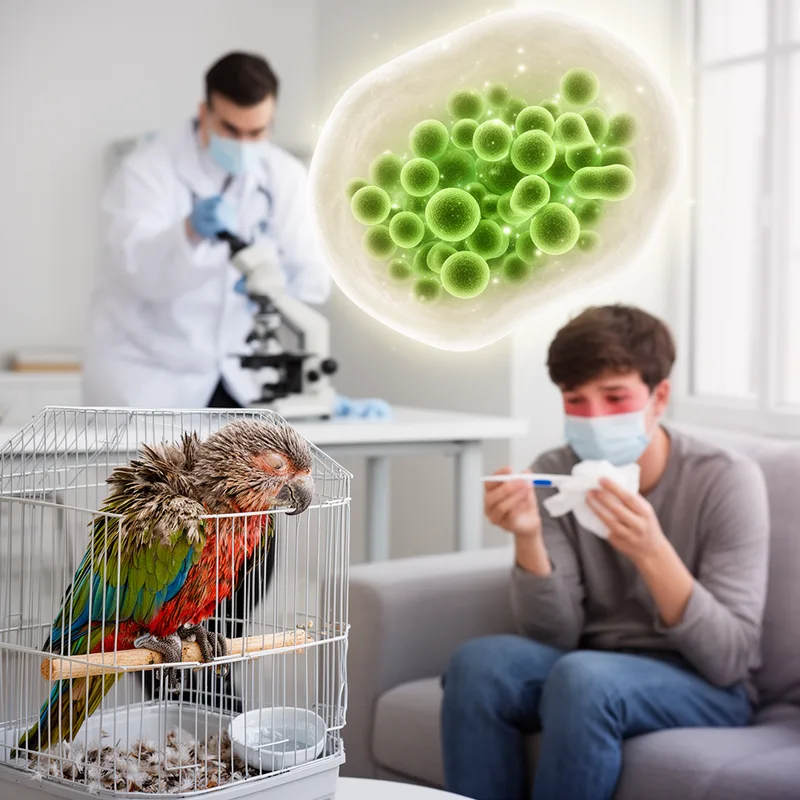
Chlamydia psittaci
- noun
- /klæˈmɪdiə sɪˈteɪsi/
- Specialized
- Infection with Chlamydia psittaci can lead to flu-like symptoms in humans.
Examples
-
Chlamydia psittaci can cause serious respiratory issues.
-
Veterinarians often treat birds infected with Chlamydia psittaci.
-
Researchers isolated Chlamydia psittaci from the infected parrot.
-
Veterinarians were concerned about Chlamydia psittaci outbreaks in captive bird populations.
-
Infection with Chlamydia psittaci can lead to flu-like symptoms in humans.
-
Veterinarians were concerned about Chlamydia psittaci outbreaks in captive bird populations.
-
Researchers isolated Chlamydia psittaci from the infected parrot.
Synonyms
A type of bacteria that causes infections in birds and can also infect people
Surface Forms
Morphology
chlamydia + psittaci
This is a scientific binomial: 'Chlamydia' clearly indicates the bacterial genus, and the combination signals a specific species, so a learner who knows both parts can infer it names a particular type of Chlamydia. However, the species epithet 'psittaci' is Latin-derived and its link to psittacine (bird) hosts and the specific disease association (psittacosis) requires domain-specific or Latin knowledge not available to an average B1 learner, so the relation is only partially predictable.
Etymology
Chlamydia psittaci gets its name from two old words. The first part, Chlamydia, may come from a Greek word for a small 'cloak' because these bacteria live hidden inside cells, and the second part, psittaci, comes from Latin for 'parrot' because the germ was first found in birds, so the name links the bacterium to hiding in cells and to the disease 'psittacosis'.

