
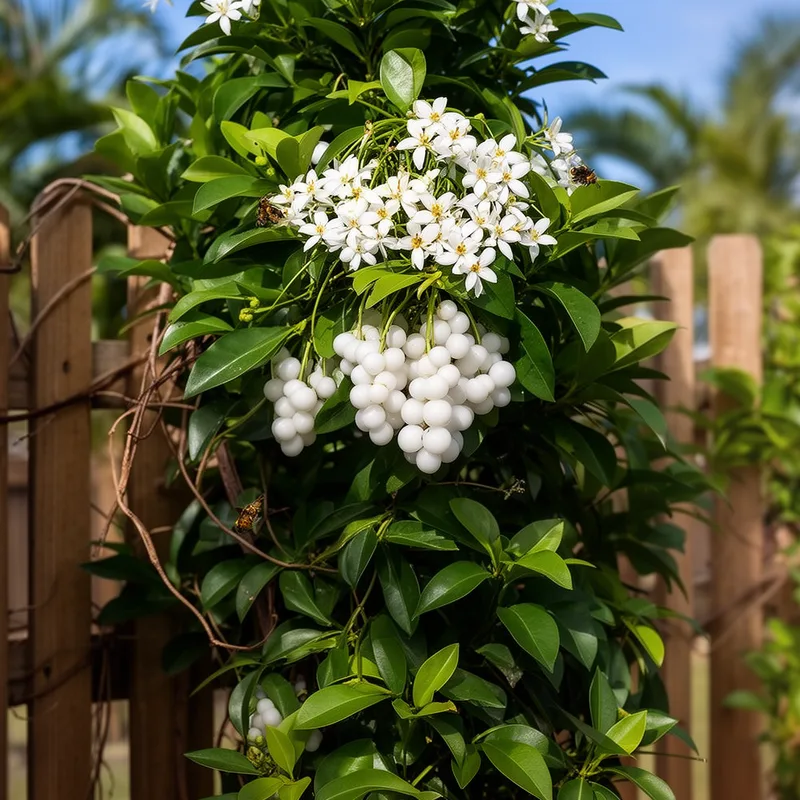
Chiococca alba
- noun
- Specialized
- The Chiococca alba in my backyard climbs along the fence and produces small, fragrant white flowers.
Examples
-
Wildlife in southern Florida feed on the succulent fruit of Chiococca alba during the summer months.
-
Gardeners in subtropical regions often plant Chiococca alba for its attractive white berries.
-
The Chiococca alba blooms beautifully in the spring.
-
Many gardeners love Chiococca alba for its fragrant flowers.
-
Gardeners in subtropical regions often plant Chiococca alba for its attractive white berries.
-
The Chiococca alba in my backyard climbs along the fence and produces small, fragrant white flowers.
-
Wildlife in southern Florida feed on the succulent fruit of Chiococca alba during the summer months.
Synonyms
An evergreen climbing bush with fragrant white flowers and round white berries

A green climbing bush with clusters of fragrant white or cream flowers and round white berries
Surface Forms
Morphology
Chiococca + alba
This is a Latin binomial composed of the genus name Chiococca and the epithet alba (Latin for 'white'), so if a learner knows both parts they can infer it denotes the white-flowered/white-berried species of Chiococca. However, botanical Latin and species-naming conventions are specialized and 'alba' is not an everyday English word, so the relation is only partially transparent for an average B1 learner.
Etymology
Chiococca alba may come from old Greek words chion and kokkos, meaning 'snow' and 'berry', and the Latin word alba meaning 'white'. So the name gives the simple image of a climbing shrub with small white berries and fragrant white flowers, and that is why this name fits the plant today.

