

Chinese gooseberry
- noun
- /ˈtʃaɪniːz ˈɡuːsbəri/
- Archaic
- Before becoming popular worldwide, the Chinese gooseberry was primarily cultivated in New Zealand for its edible fruit.
Examples
-
The Chinese gooseberry was rebranded as 'kiwi' when it was exported from New Zealand.
-
The Chinese gooseberry is also known as kiwi.
-
Before becoming popular worldwide, the Chinese gooseberry was mostly grown in its native China.
-
Some older cookbooks list Chinese gooseberry as an ingredient instead of kiwi fruit.
-
Have you tried a Chinese gooseberry before?
-
Some older recipes still refer to Chinese gooseberry rather than the more common name, kiwi.
-
The Chinese gooseberry is recognized for its fuzzy brown skin and sweet green flesh.
Synonyms

 4
2.7
4
2.7

A climbing plant from China grown for its fuzzy brown fruit
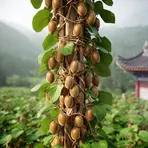
A climbing plant from China that produces the fuzzy brown kiwifruit

A climbing plant grown for its fuzzy, green fruit

A climbing vine from China that produces edible kiwifruit
Surface Forms
Morphology
The compound is a straightforward origin+thing construction: 'Chinese' indicates origin and 'gooseberry' names a type of berry, so a learner who knows both words will infer it denotes a berry (or fruit) associated with China. Although historically the term refers to what is now called the kiwi fruit (which is not a true gooseberry), the meaning is still compositionally transparent and predictable to B1 learners.
Etymology
Chinese gooseberry for the plant comes from the same image: the climbing vine was Chinese and it made fuzzy fruits like a gooseberry, so the name came to mean the vine that grows the fruit, even though people now usually call the fruit 'kiwi' or 'kiwifruit'.