
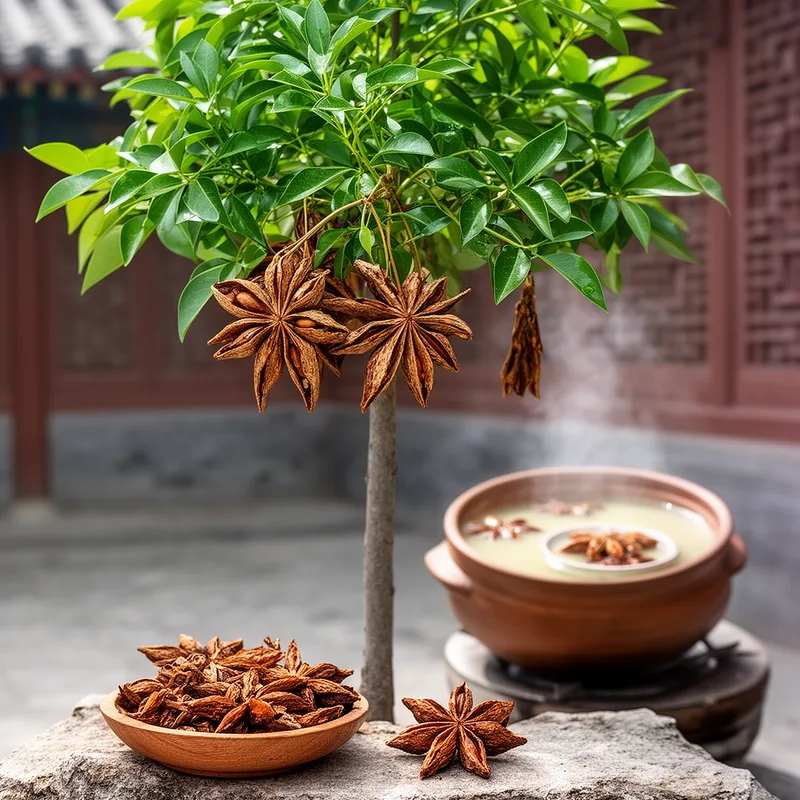
Chinese anise
- noun
- /ˈtʃaɪniːz ˈænɪs/
- Her recipe calls for one Chinese anise pod to enhance the flavor of the broth.
Examples
-
Traditional medicine often uses Chinese anise for its digestive benefits.
-
Adding Chinese anise to the stew gives it a distinct spicy aroma.
-
I bought some Chinese anise from the local market.
-
Many chefs use Chinese anise in their recipes.
-
Adding Chinese anise to the stew gives it a distinct spicy aroma.
-
Many chefs use Chinese anise in their recipes to add flavor.
-
Traditional medicine often utilizes Chinese anise for its digestive benefits.
Synonyms

A small tree from China and Vietnam with star-shaped fruit that smell of anise and are used as a spice

An evergreen shrub or tree with strong-smelling leaves and seeds used as a spice and for scent

A small evergreen tree that makes star-shaped fruit used as a spice
Surface Forms
Morphology
The noun phrase is fully compositional: 'Chinese' specifies origin/variety and 'anise' names the spice, so a learner who knows both words can infer it refers to a type of anise associated with China (i.e. star anise used in Asian cooking). This adjectival-origin + noun pattern is cross-linguistically common and follows transparent English noun-modifier composition, making the meaning predictable for a B1 learner.
Etymology
Chinese anise comes from a small tree in China and Vietnam whose fruit smells like the common spice anise. People used the tree in cooking and as a simple 'medicine', so the name helps you remember it is a Chinese plant used for a spicy, healing flavor.

