

Cercis canadensis
- noun
- Specialized
- The Cercis canadensis is often planted in gardens for its vibrant spring blossoms.
Examples
-
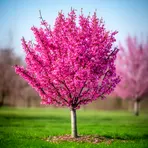
In early spring, the branches of Cercis canadensis are covered with clusters of pink flowers.
-
Wildlife such as bees and butterflies are attracted to the Cercis canadensis during its flowering season.
-
Look at that beautiful Cercis canadensis tree!
-
My Cercis canadensis is blooming!
-
In spring, the Cercis canadensis blooms with beautiful pink flowers, attracting many pollinators.
-
The Cercis canadensis, also known as the eastern redbud, can be found lining the streets of many parks in the region.
-
Gardeners love the Cercis canadensis for its stunning display of pink blossoms that brighten up any landscape.
Synonyms
 1
8.1
1
8.1

A small tree with bright pink flowers in spring
Surface Forms
Morphology
The Latin binomial is directly compositional: the genus name 'Cercis' denotes redbuds and the species epithet 'canadensis' denotes origin associated with Canada, so the compound denotes a redbud species from that region. This follows standard taxonomic naming logic (common cross-linguistically), so a learner who knows both constituents and basic binomial conventions can infer the meaning, albeit it is specialized scientific vocabulary.
Etymology
Cercis canadensis may come from the Greek word Cercis for a 'weaver's shuttle', because the tree's long, flat seed pods look like a small shuttle. The second part, canadensis, means 'from Canada' or North America, so the full name tells you this is the Cercis tree that grows in eastern North America, the 'eastern redbud'.