
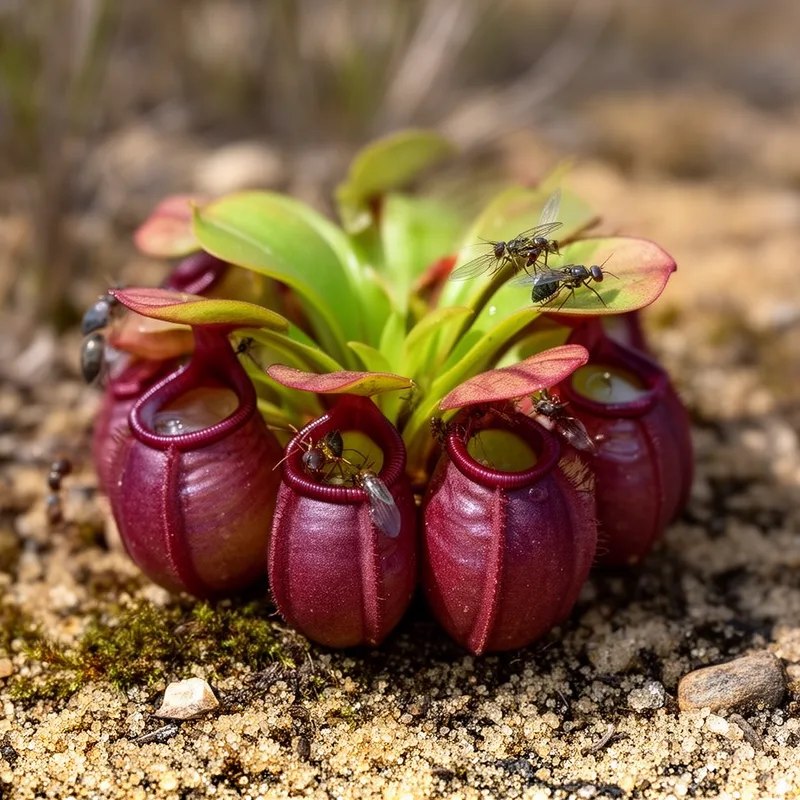
Cephalotus follicularis
- noun
- /sɛfəˈloʊtəs fɒlɪˈkjʊlərɪs/
- Specialized
- The Cephalotus follicularis is prized by collectors for its unique insect-trapping leaves.
Examples
-
In her greenhouse, she successfully cultivated several Cephalotus follicularis plants.
-
Botanists studied how the Cephalotus follicularis adapts to nutrient-poor soils.
-
The Cephalotus follicularis is a fascinating plant.
-
I saw a Cephalotus follicularis at the botanical garden.
-
Botanists studied how the Cephalotus follicularis adapts to nutrient-poor soils.
-
In her greenhouse, she successfully cultivated several Cephalotus follicularis plants.
-
The Cephalotus follicularis is prized by collectors for its unique insect-trapping leaves.
Synonyms
A Western Australian plant that catches insects with green pitcher-shaped leaves with a red edge on the lid
Surface Forms
Morphology
Cephalotus + follicularis
This is a Linnaean binomial combining the genus name Cephalotus (a carnivorous-plant genus) with a species epithet; a learner who knows the constituents can infer it refers to a particular species within the Cephalotus genus. While specific attributes (native range, pitcher morphology) are not recoverable from the name alone, the basic sense 'a species of Cephalotus' is transparently compositional and follows cross-linguistic taxonomic conventions.
Etymology
Cephalotus follicularis may come from old Greek and Latin words: Cephalotus from a Greek word for 'head' and follicularis from a Latin word for 'small bag'. The plant's leaves look like little pitcher-shaped 'bags' that trap insects, so the name points to its insect-trapping leaves.

