
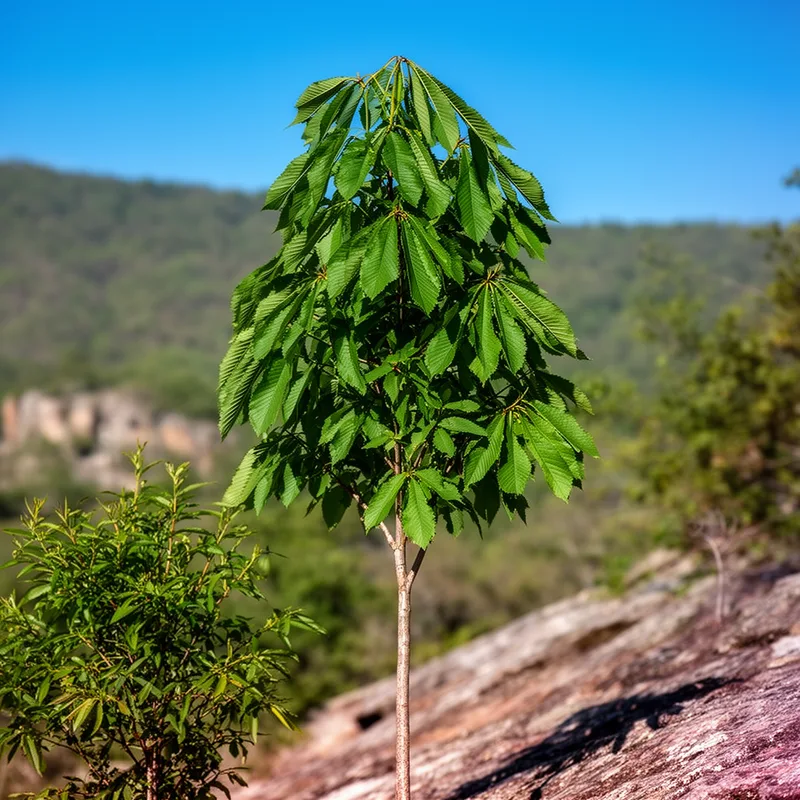
Castanea ozarkensis
- noun
- Specialized
- The leaves of Castanea ozarkensis are larger than those of its close relative, the Allegheny chinkapin.
Examples
-
The rare Castanea ozarkensis is found primarily in the Ozark Mountains.
-
Conservationists are working to protect Castanea ozarkensis from blight and habitat loss.
-
The Castanea ozarkensis thrives in the rich soil of southern Missouri.
-
Many gardeners are interested in planting Castanea ozarkensis for its beautiful foliage.
-
Conservationists are working to protect Castanea ozarkensis from blight and habitat loss.
-
The leaves of Castanea ozarkensis are larger than those of its close relative, the Allegheny chinkapin.
-
The Castanea ozarkensis thrives in the rich soil of southern Missouri.
Synonyms

A small shrubby tree with large leaves that grows in the southern Midwest United States

A small bushy tree native to the Ozark region with larger leaves and nuts animals eat
Surface Forms
Morphology
Castanea + ozarkensis
The binomial combines the genus name 'Castanea' (a group of chestnut trees) with the Latin toponymic epithet 'ozarkensis' (meaning 'from the Ozarks'), so the sense — a species of Castanea native to the Ozarks — is directly derivable from its parts. Linnaean taxonomic naming is cross-linguistically regular, so a learner who knows both constituents can transparently infer that this refers to a particular tree species.
Etymology
Castanea ozarkensis comes from two parts: Castanea meaning 'chestnut' and ozarkensis meaning 'from the Ozarks'. So the name literally means 'a chestnut plant from the Ozark Mountains', which helps you remember that it is a small, bushy tree found in that region.

