
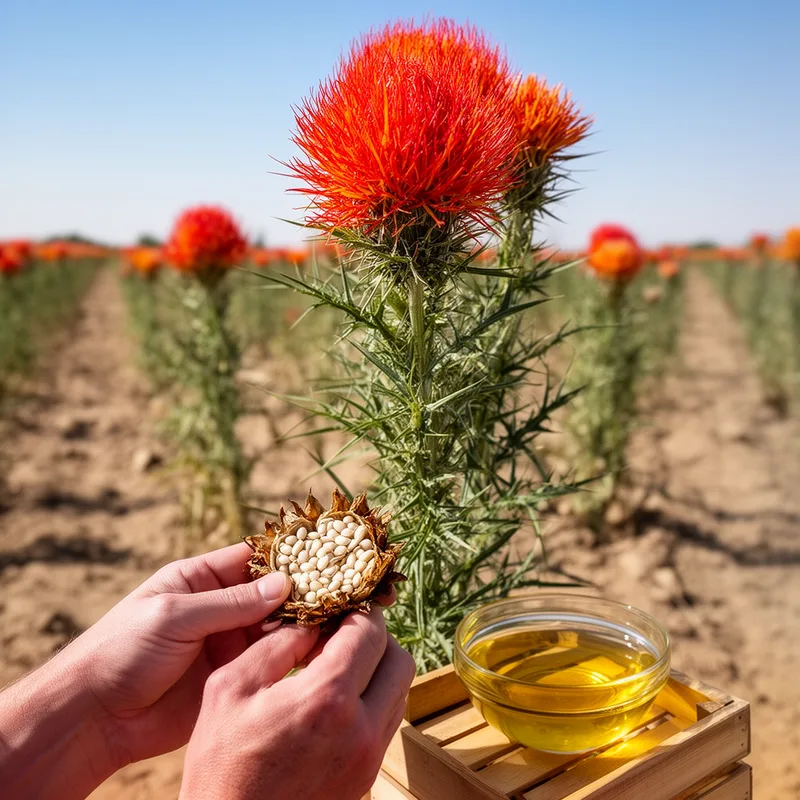
Carthamus tinctorius
- noun
- Specialized
- The oil extracted from Carthamus tinctorius is considered one of the healthiest vegetable oils.
Examples
-
Farmers in arid regions often cultivate Carthamus tinctorius for its drought resistance and commercial value.
-
Botanists have studied Carthamus tinctorius for its medicinal properties and use in food coloring.
-
The Carthamus tinctorius is known for its vibrant flowers.
-
Farmers cultivate Carthamus tinctorius for its oil.
-
Farmers commonly grow Carthamus tinctorius to produce oil from its seeds.
-
The seeds of Carthamus tinctorius are harvested for their valuable oil used in cooking.
-
Known for its striking orange flowers, Carthamus tinctorius is often cultivated in gardens and fields.
Synonyms

 1
7.9
1
7.9

A plant with red or orange flowers grown for seeds that make oil

A plant like a thistle with red or orange flowers whose seeds make an oil used instead of saffron
Surface Forms
Morphology
Carthamus + tinctorius
This is a Latin scientific name (binomial) rather than a compositional English phrase, and the species epithet 'tinctorius' is not an English lexical item here. A B1 learner who knows the listed constituents would not be able to derive the specific botanical meaning (‘a thistlelike Eurasian plant cultivated for its oil’) from those taxonomic elements, so the expression is not transparently interpretable.
Etymology
Carthamus tinctorius gets its name from old words about dyeing, and the second part, tinctorius, means 'used for dyeing'. People long ago used the bright red-orange flowers to make color for cloth and to make oil, so the name helps you remember the plant was used for dye and useful oil.