
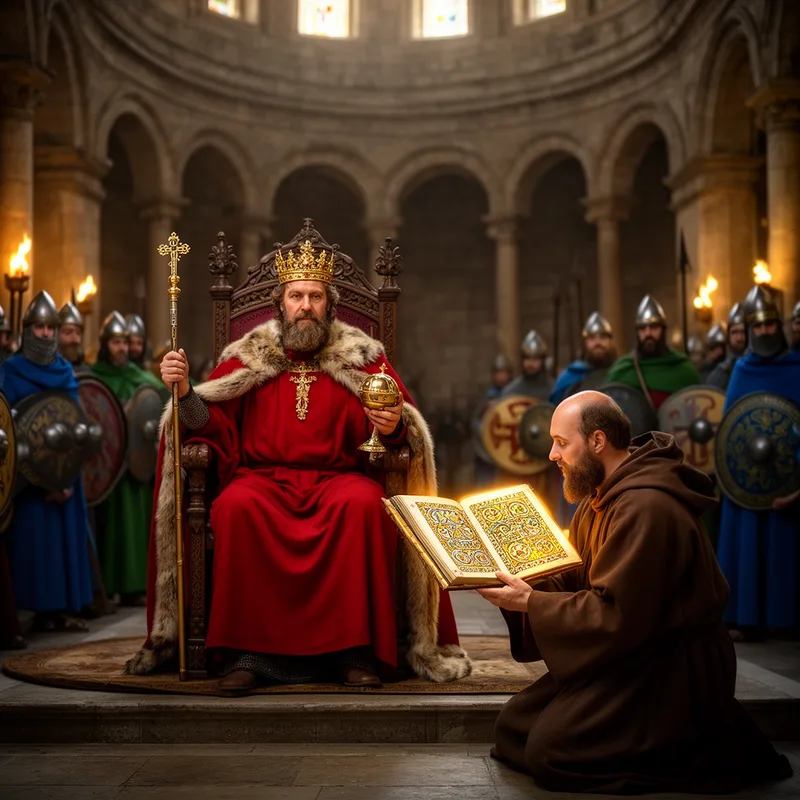
Carolingian


 1
9.9
1
9.9
- adjective
- /ˌkɛrəˈlɪndʒən/
- The architectural style of many churches reflects the distinct features of Carolingian design, emphasizing grand arches and spacious interiors.
- Carolingian period
Loading YouTube…
Watch on YouTubeOK, so we've reached the height of the Carolingian Empire in two days.
- OK, so we've reached the height of the Carolingian Empire in two days.
- The Vikings, which we'll end the course with, are certainly less developed, economically, less civilized than the Carolingian Empire that they plunder.
Examples
-
Relationships between the Church and the empire during the Carolingian period were also complex and often problematic.
Academic text (2002) -
In essence, then, Carolingian leges may have illustrated the sacred landscape of the Carolingian world and its churches, but they did little to produce that landscape.
Academic text (2018) -
During the Carolingian period, we find a growing tendency to make marriage an ecclesiastical affair.
Academic text (2009) -
Regardless of terminology, Carolingian legislation shows significant spatial diversity and complexity.
Academic text (2018) -
Historians studying the Carolingian world are thus well placed to embrace social scientific methods and employ space as a methodological tool.
Academic text (2018) -
Cultural history tells us that the relations of peoples to the church in early Ireland and in Carolingian Gaul were founded in a form of gift exchange, each side receiving recognition and protection from the other so that the relationship was seen as beneficial to all.
Academic text (2006) -
Carolingian texts include numerous references to Old Testament leaders, including Moses, as prototypes for Frankish rulers.
Academic text (1991) -
Like rites, practices were concrete, with Carolingian princes and prelates emphasizing, for instance, Sunday rest, a demarcation of time and of human labor.
Academic text (2002) -
Previously, consular meetings had often convened in a city's episcopal complex, since bishops had moved in to fill power vacuums after the dissolution of the Carolingian Empire in Italy in the late ninth century.
Academic text (2015) -
Art from the Carolingian period often includes intricate illumination and detailed manuscript illustrations.
Compounds
Surface Forms
Morphology
Carolingian = caroling + ian
Formed from a historical dynastic name plus the adjectival suffix '-ian'; knowing common English morphemes will not help a learner infer the historical reference or period.
Etymology
Carolingian comes from the Latin name Carolus, 'Charles', after Charlemagne. As an adjective, Carolingian means 'from the time or style of that family', so it describes things from their rule.