

Caesalpinia echinata
- noun
- Specialized
- The prized wood of the Caesalpinia echinata has been exported for centuries.
Examples
-
Dyes extracted from Caesalpinia echinata were once used to color textiles in Europe.
-
Many musical instruments are still made from the sturdy wood of Caesalpinia echinata.
-
The Caesalpinia echinata tree can grow up to 30 feet tall.
-
Many craftsmen prefer Caesalpinia echinata for its durability.
-
The hard red wood of Caesalpinia echinata is highly sought after for making fine furniture.
-
Artisans often choose Caesalpinia echinata because of its strong and beautiful grain pattern.
-
Historically, Caesalpinia echinata was harvested for its red dye, which was used in fabric production.
Synonyms

Hard red wood from a tropical tree with a prickly trunk used for cabinets and dye
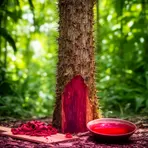
A tropical tree with a prickly trunk and dense red wood used for dye
Surface Forms
Morphology
Caesalpinia + echinata
The binomial name combines a genus (Caesalpinia = a tropical tree) with a specific epithet (echinata) that, if known from Latin, means 'spiny' or 'prickly', so a learner who knows both constituents could infer this refers to a spiny Caesalpinia and thus predict the prickly trunk. However, the full botanical details in the definition (heavy red wood used for cabinetry and dye) are species-specific facts not derivable from the name alone, and the epithet is a specialized/Latin term that typical B1 learners are unlikely to know, so the relation is only partially transparent.
Etymology
Caesalpinia echinata is the tree known for a strong 'red dye' and heavy red wood that looks like glowing 'embers'. One popular story says Portuguese called it 'pau-brasil' after the word 'brasa' for 'ember', and that fiery color and hard wood explain why it was so prized for fine furniture and musical instruments.

