

British House of Commons
 1
3.6
1
3.6

- proper noun
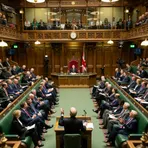
- The British House of Commons is responsible for debating and passing important laws in the United Kingdom.
- British House of Commons committee
Examples
-
In 1774, Elwes was offered a chance to succeed a retiring Member of Parliament in the British House of Commons, and accepted... provided he wouldn't have to spend money on his campaign.
Blog text (7) -
The International Development Committee of the British House of Commons, in its second report on the future of sanctions, summed up the overall experience of sanctions and the policy options which follow from it as follows:
Academic text (2001) -
In April 1989, a select committee of the British House of Commons held hearings in Hong Kong for the purpose of listening to the desires of Hong Kong residents.
Academic text (1990) -
Following the release of the British House of Commons committee report in late June 1989, Hong Kong's government and people continued working diligently to obtain the right of abode for all BDTCs.
Academic text (1990) -
On 20 December 1989, Douglas Hurd announced who succeeded Major as foreign secretary in another round of cabinet reshuffling in late October and announced Britain's new policy on Hong Kong in the British House of Commons.
Academic text (1990) -
Many citizens follow the discussions held in the British House of Commons, as they can affect everyday life.
-
Decisions made by the British House of Commons often influence the country's policies and direction.
Synonyms
 5
3.3
5
3.3
The elected part of the British Parliament that makes laws and represents the public
Surface Forms
Morphology
British + house + of + commons
The phrase transparently composes 'house' (an assembly or chamber) with 'commons' (the common people), so a learner who knows those words can infer it denotes an assembly representing ordinary citizens — i.e. a legislative body. This compositional logic is common cross-linguistically (e.g. French 'Chambre des Communes') and follows normal English noun-of-noun patterns, so B1 learners can grasp the general meaning even if they may not know the technical detail of it being the elected lower chamber.
Etymology
British House of Commons comes from older times when a house of 'common' people, local townspeople rather than the nobles, met to speak for their communities, and Commons meant those common people. That's why today the British House of Commons is the elected part of Parliament where representatives of the public meet to make and pass laws.