

Branta canadensis
- noun
- /ˈbræntə kəˈnædɪsɪs/
- Specialized
- Wildlife biologists are studying the nesting habits of Branta canadensis near urban lakes.
Examples
-
A flock of Branta canadensis was seen migrating south for the winter.
-
Many people enjoy watching Branta canadensis during migration.
-
The park is home to many species, including the ubiquitous Branta canadensis.
-
The Branta canadensis is often seen near lakes.
-
A flock of Branta canadensis was seen migrating south for the winter.
-
Wildlife biologists are studying the nesting habits of Branta canadensis near urban lakes.
-
Many people enjoy watching Branta canadensis during migration.
Synonyms
 3
2.7
3
2.7

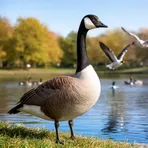
A large wild goose from North America with a black head and neck and white cheeks
 1
3.2
1
3.2
A large wild goose with a black head and white cheek patches that honks loudly and is often near lakes
 1
9.3
1
9.3
A Canada goose that makes a loud long sound
Surface Forms
Morphology
This is a scientific binomial composed of the genus name 'Branta' (a group of geese) and the species epithet 'canadensis' (literally 'from Canada'); if a learner knows those constituents they can infer it denotes the Canada goose. Taxonomic Latin names are compositional and follow predictable cross-linguistic conventions, so the meaning is transparently derived from the parts.
Etymology
Branta canadensis is the scientific name for the Canada goose. The second part, canadensis, means 'from Canada', and Branta was an old word for dark or black-necked geese, so the name creates the image of a dark-necked goose from Canada and explains why it refers to the common Canada goose today.