
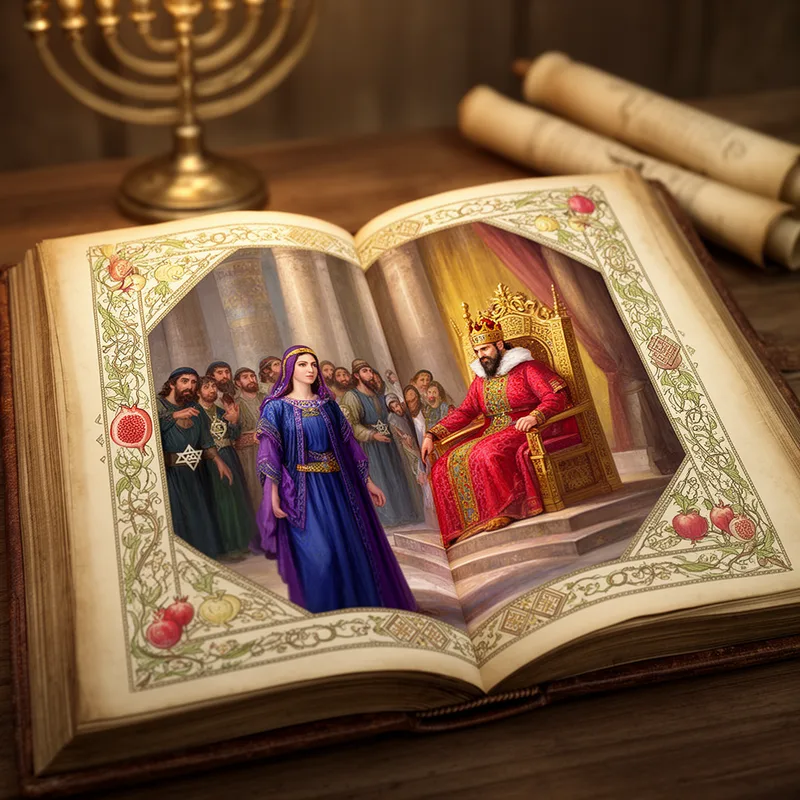
Book of Esther
 1
6.4
1
6.4

- proper noun
- /bʊk əv ˈɛstər/
- The Book of Esther is unique among the Old Testament books as it does not mention God explicitly.
Examples
-
There I began to see a larger pattern, including the story of Shechem in Genesis, the destruction of Jericho in the book of Judges, the story of Amalek in the book of Kings, and the bloodletting at the end of the book of Esther.
Blog text (7) -
From the book of Esther.
-
"Thus, according to Schnur, the first two chapters of the Book of Esther" represent one of Purim's many core 'reversals'; that is, they represent a male revolt against women.
Academic text (2010) -
As told in the Book of Esther, the saga of Purim begins when the king of Persia, Ahasuerus, holds a banquet and asks his wife, Queen Vashti, to display her beauty before him.
Academic text (2010) -
During the Jewish festival of Purim, we always read the Book of Esther to remember Esther's bravery.
-
In the Book of Esther, a Jewish woman named Esther rises to be queen and saves her people from danger.
Synonyms
 19
5.6
19
5.6
A book in the Old Testament about a Jewish woman who becomes queen and saves her people
Surface Forms
Morphology
The phrase is a straightforward possessive/title construction: 'book' + 'of' + the name 'Esther' yields a book about or belonging to Esther, so a learner who knows the constituent words can infer it refers to the book concerning Esther's story. The 'Book of X' pattern is cross-linguistically common (e.g., Libro de X), making the meaning immediately comprehensible to B1 learners who know the words.
Etymology
Book of Esther is named after Esther, a Jewish woman who became queen long ago in Persia. She risked her life by going before the king to reveal a plot to kill her people, so the book tells a vivid story of 'bravery' and how she 'saved' her people and is the reason for the festival of Purim.