
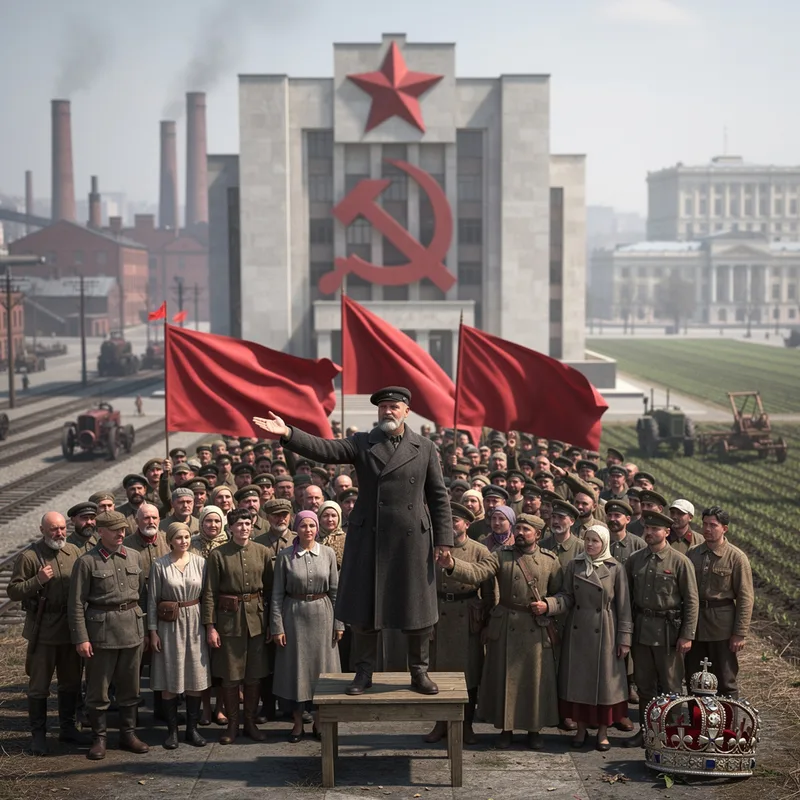
Bolshevism
 2
9.2
2
9.2

- noun
- /ˈbɔlʃəˌvɪzəm/
- For Eastman, Bolshevism was both Utopian and pragmatic.
Loading YouTube…
Watch on YouTubeSo what did Nazism and Bolshevism and Communism share or how were they opposed to one another?
- So what did Nazism and Bolshevism and Communism share or how were they opposed to one another?
- But he says, not that I do supplement myself, but the whole problem was that a politicized electorate always either ends in Bolshevism or fascism.
- And because remember, the German Workers Party is trying to cast itself as a counter Bolshevism.
- Einstein is from a Jewish family and further E anti-Semitism is running up against the current trend of anti Bolshevism.
Examples
-
The next period in the development of Bolshevism Lenin called the years of reaction (1907-1910).
Blog text (22) -
The image of the Bolshevik as one with American labor would come to dominate the magazine's portrayal of Bolshevism and, in turn, communism.
Academic text (2002) -
We were a bulwark against Bolshevism.
-
It's like talking about Bolshevism and referring to Khrushchev.
-
According to Schmidt, with the threat of Bolshevism removed, Germany would now grow in strength of spirit and morality.
Academic text (2018) -
Like Ledochowski, he viewed Bolshevism as the principal enemy.
Academic text (1998) -
Lenin, by successfully establishing Bolshevism in Russia, threatened to cause a global polarization on class lines.
Academic text (1993) -
Esenin placed all his faith in this redemptive Bolshevism, savior of the world.
Academic text (1991) -
The image aligns Christ with the masses and serves to belie the misrepresentation of Bolshevism by the press.
Academic text (2002) -
Throughout the 20th century, many Western nations developed policies to counteract the spread of Bolshevism.
Synonyms
 4
8.8
4
8.8
Political ideas by Vladimir Lenin about how a small party should lead a workers' revolution
 1
7.4
1
7.4
A political view that says workers should control society under one leading party, based on Marx and Lenin

A political system and ideas from the former Soviet Union's communist government
Compounds

- Slur
A false idea that links Jewish people with Bolshevik communism and harms Jews

- Slur
A false belief that Jewish people secretly support or control communist movements
Surface Forms
Morphology
Etymology
Bolshevism comes from Bolshevik, the name of a Russian group whose word bol'shoy means 'big' or 'more'. Because the Bolsheviks called themselves the 'majority', Bolshevism means the political ideas and rule of that group in Russia.