
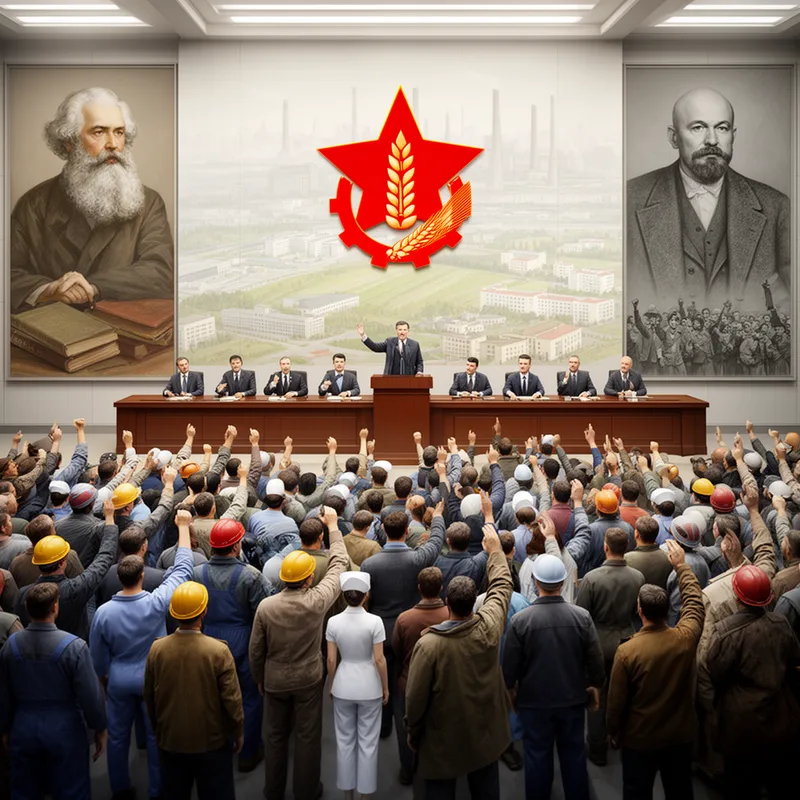
Marxism-Leninism
 1
7.4
1
7.4

- noun
- /ˈmɑrkˌsɪzəm ˈlɛnɪnɪzəm/
- Many scholars argue that the principles of Marxism-Leninism have failed to adapt to modern economic challenges.
- collapse of Marxism-Leninism
Examples
-
During the seminar, we discussed the key principles of Marxism-Leninism and its impact on worldwide communist movements.
-
The influence of Marxism-Leninism shaped the political landscape of the Soviet Union for decades.
-
For us, Marxism-Leninism was not something we chose out of a book.
Academic text (1992) -
I had been preparing the talk that I was to give at our next seminar on the history of Marxism-Leninism.
Fiction book (1991) -
Universities throughout China began offering more courses on politics, great persons of Chinese history, and orthodox Marxism-Leninism.
Academic text (2002) -
The conviction remains that Marxism-Leninism is incompatible with Chinese society.
Academic text (1992) -
Chinese intellectuals have long hypothesized that Marxism-Leninism is incompatible with China's society and cultural tradition.
Academic text (1992) -
Having removed Emperor Haile Selassie from power, the Derg ruled until 1991 under the banner of Marxism-Leninism.
Academic text (1993) -
By 1997, at the Fifteenth Party Congress, Deng Xiaoping Theory was enshrined in the constitution, together with Marxism-Leninism and Mao Zedong Thought as China's permanent "guide to action."
Academic text (2003)
Synonyms
 4
8.8
4
8.8
Political ideas by Vladimir Lenin about how a small party should lead a workers' revolution
A political system and ideas from the former Soviet Union's communist government
How Marxist

Surface Forms
Morphology
Etymology
Marxism-Leninism is named for the thinkers Marx and Lenin, with the ending -ism meaning 'a system of ideas'. It refers to the combined political and economic ideas of Karl Marx and Vladimir Lenin and the way the Soviet Union ran its government and economy.