
Beta vulgaris cicla
- noun
- Specialized
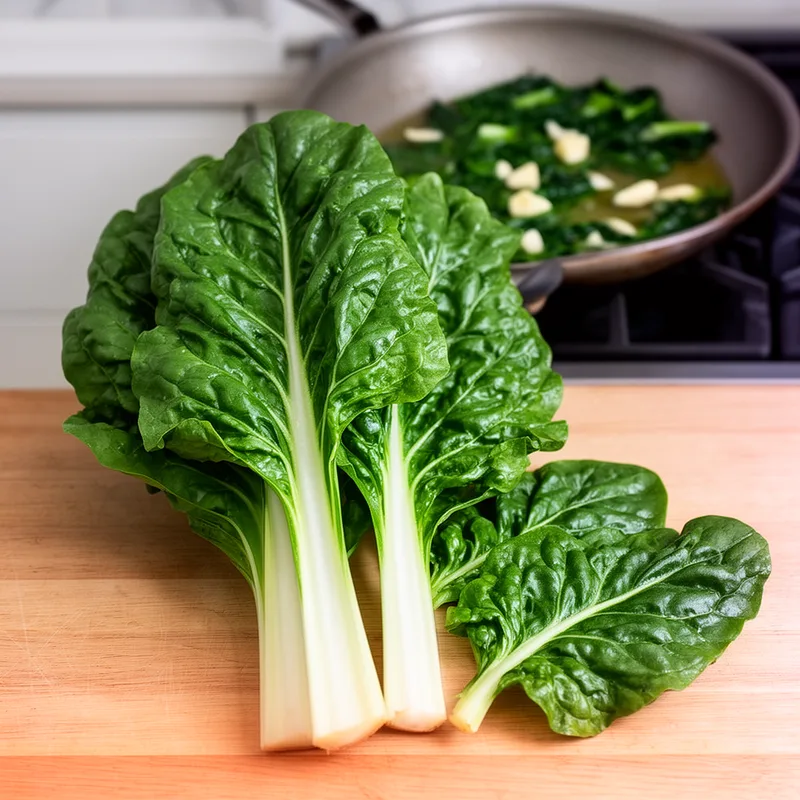
- We sautéed the Beta vulgaris cicla leaves with garlic for a nutritious side dish.
Examples
-
The farmer grows several rows of Beta vulgaris cicla in his organic vegetable plot.
-
I love adding Beta vulgaris cicla to my salads.
-
Many Mediterranean dishes feature Beta vulgaris cicla as a key ingredient.
-
Have you ever tried Beta vulgaris cicla in a stir-fry?
-
Many Mediterranean dishes feature Beta vulgaris cicla as a key ingredient.
-
The farmer grows several rows of Beta vulgaris cicla in his organic vegetable plot.
-
We sautéed the Beta vulgaris cicla leaves with garlic for a nutritious side dish.
Synonyms

 8
4.8
8
4.8

A leafy vegetable with large green leaves and thick stems eaten cooked or raw
 3
3.0
3
3.0
A leafy green vegetable with large leaves and thick colorful stalks

A leafy vegetable with edible stems and leaves, like Swiss chard

A vegetable with large green leaves and thick stalks that people grow for its edible stems and leaves

A leafy vegetable grown for its leaves and stalks instead of its root
Surface Forms
Morphology
This is a Latin botanical binomial (taxonomic name) whose parts are labels rather than a compositional English phrase; knowing 'beta' as a Greek letter and 'vulgaris' as an epithet does not let a learner infer 'Swiss chard', and 'cicla' is not a transparent English word. The overall meaning is specialized, terminological knowledge rather than predictable from the constituents, so a B1 learner would not be able to derive it.
Etymology
Beta vulgaris cicla comes from old Latin plant naming: Beta is the beet group, vulgaris means 'common', and cicla points to the leafy chard form. So the name says 'common leafy beet', which helps you remember that Beta vulgaris cicla is the vegetable we call Swiss chard.