
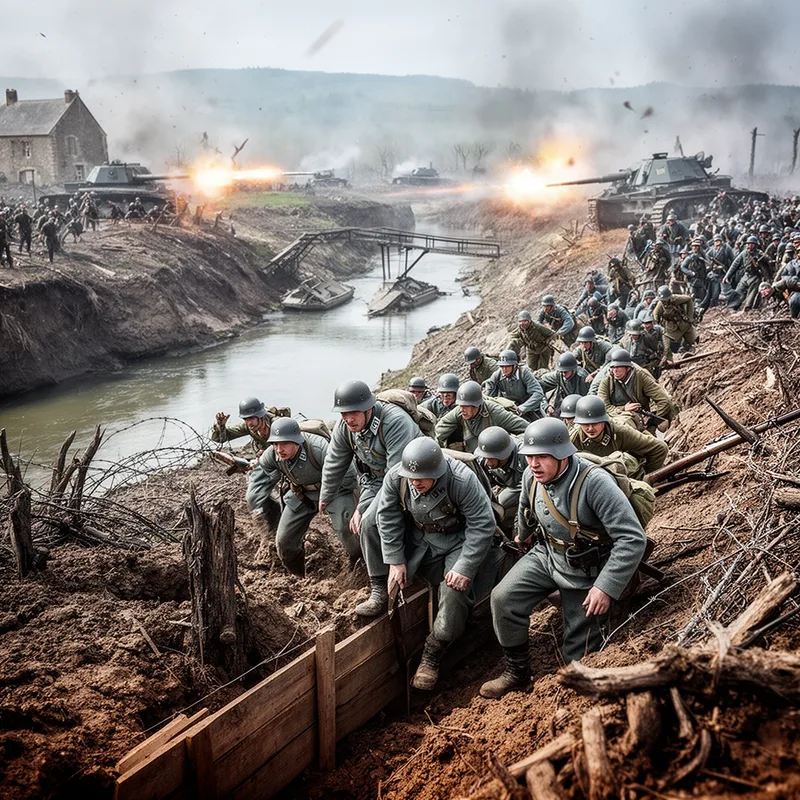
Battle of the Aisne
- proper noun
- Did the Battle of the Aisne change the course of the war?
Examples
-
Remnants from the Battle of the Aisne can still be seen in the fields of northern France.
-
The Battle of the Aisne marked a significant turning point in the final year of World War I.
-
Historians still debate the strategic consequences of the Battle of the Aisne for both sides.
-
The Battle of the Aisne was a significant event in World War I.
-
The Battle of the Aisne in May 1918 marked a significant attempt by German forces to breach Allied lines.
-
During the Battle of the Aisne, the German army made some tactical gains despite suffering heavy losses.
-
The outcome of the Battle of the Aisne highlighted the strategic failures faced by German forces in World War I.
Synonyms
Major World War I battle in May 1918 near the Aisne River when German troops made a large attack
A World War I battle in France in May 1918 where a German attack first succeeds but later fails

A World War I battle in May 1918 where a German attack fails despite early gains
A World War I battle in May 1918 where a German victory did not stop the Allied advance
Surface Forms
Morphology
battle + of + the + Aisne
The headword is compositionally built from 'battle' + 'of' + the place-name 'Aisne'; a B1 learner who knows 'battle' and recognises 'Aisne' as a proper place name will readily infer it denotes a battle that occurred at/near the Aisne. While the precise historical details (World War I, May 1918, tactical/strategic outcomes) are not derivable from the words, the core locative/compositional meaning is transparent.
Etymology
Battle of the Aisne takes its name from the river Aisne and the fields beside it, where soldiers fought and dug trenches during World War I. Because a battle is often named for the place it happened, the phrase now refers to that big 1918 'attack' and the fighting in that area.

