

Battle of Waterloo
 2
5.8
2
5.8

- noun
- /ˈbætəl əv ˈwɔtərloʊ/
- The Duke of Wellington led the allied forces to victory in the decisive Battle of Waterloo.
Examples
-
Nathan Rothschild built a significant chunk of his fortune by using a system of couriers who told him the result of the Battle of Waterloo a full day before anybody else in London knew it.
Blog text (15) -
Most people know that Waterloo refers to the defeat and fall of Napoleon at the Battle of Waterloo.
Blog text (16) -
Four days later, the Battle of Waterloo took place, news of which was received on the late evening of June 21.
Academic text (2018) -
Of course, there are historical events enacted in public whose outcome is clear: the Battle of Waterloo, for example.
Academic text (1991) -
Scharf was a German who settled in London after serving on the British side at the Battle of Waterloo.
Academic text (2001) -
After he loses the Battle of Waterloo, Napoleon isolates himself on the tiny island of Saint Helena.
-
Richard Whatley, in a paper written a few years after the Battle of Waterloo, argued that the evidence for his career made Napoleon appear so extraordinary that it would certainly not have been accepted if attributed to some Israelite or other king in ancient times.
Academic text (1991) -
Ironically, after the Battle of Waterloo sealed Bonaparte's fate, the service was given to the victorious General Wellington by Louis XVIII in the hopes that the British would look favorably on him and support his return to the French throne.
Academic text (2004) -
The Battle of Waterloo was fought on 18 June 1815, marking the end of Napoleon's rule.
-
Historians analyze the strategies used in the Battle of Waterloo to understand its impact on Europe.
Synonyms
 9
7.9
9
7.9
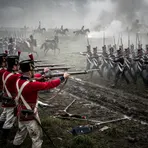
A large battle in 1815 where British and Prussian armies defeat Napoleon
How Decisive

Surface Forms
Morphology
The phrase is compositionally transparent: a B1 learner who knows 'battle' and the place-name 'Waterloo' will understand it refers to a battle that took place at Waterloo. While learners may not know the specific historical significance or date, the core referential meaning is directly derivable from the constituent words and follows common noun-of-place naming patterns found across languages.
Etymology
Battle of Waterloo names the real fight near the town Waterloo in 1815, when armies from other countries beat Napoleon and ended his rule. So today Battle of Waterloo refers to that 'final defeat' of Napoleon.