
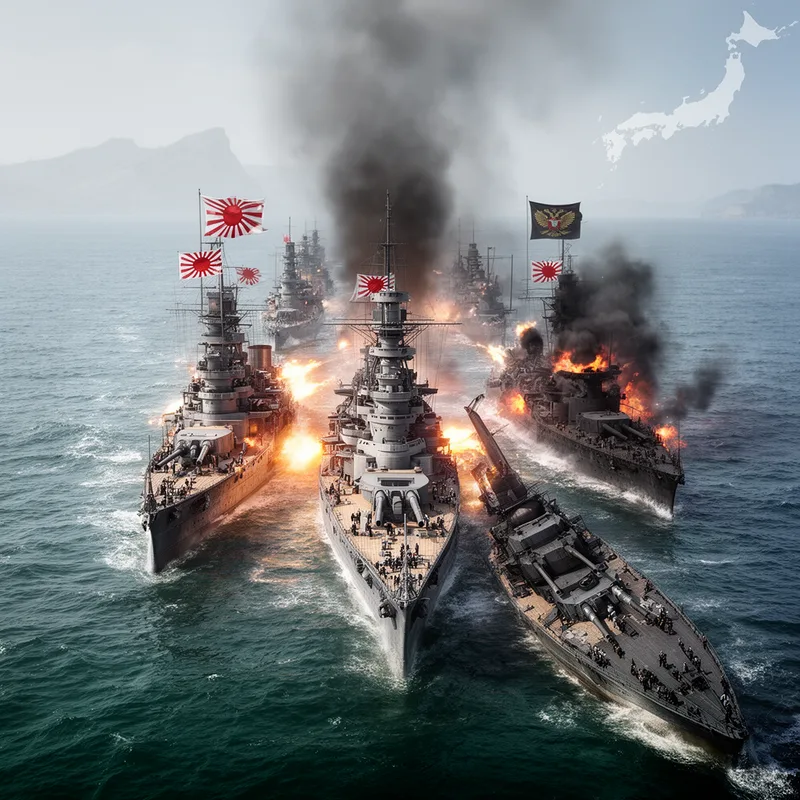
Battle of Tsushima


 1
9.1
- noun
- During the Battle of Tsushima, the Japanese fleet decisively defeated the Russian fleet in a stunning naval confrontation.
- the fleet at the Battle of Tsushima
Examples
-
A few days later, however, on 27 and 28 May 1905, the mostly British-built Japanese battle fleet pulled off a stunning upset victory against the Russian fleet at the Battle of Tsushima Straits.
Academic text (2008) -
The Battle of Tsushima in 1905 was a turning point that showcased Japan's naval superiority over Russia.
-
As far as military defeat leading to revolution goes, I imagine you'll be discussing the Battle of Tsushima next week?
Blog text (20) -
The naval strategies employed in the Battle of Tsushima influenced future maritime warfare tactics significantly.
Synonyms
 1
9.9
A naval battle in 1905 in which Japan defeats Russia in the Korean Strait
How Decisive
1
9.1
 2
4.0
Surface Forms
Morphology
This is a transparent toponymic construction: 'battle of X' straightforwardly means a battle that took place at or involved X. A B1 learner who knows 'battle' and recognizes 'Tsushima' as a place can derive the basic meaning (a specific military engagement at Tsushima), although historical details like date or participants require extra world knowledge.
Etymology
The Battle of Tsushima is named for the island of Tsushima, where Japanese and Russian ships met in 1905 in a fierce fight at sea. Many Russian ships were sunk and Japan won, so the name today stands for an important sea battle and a 'turning point' in world power.