
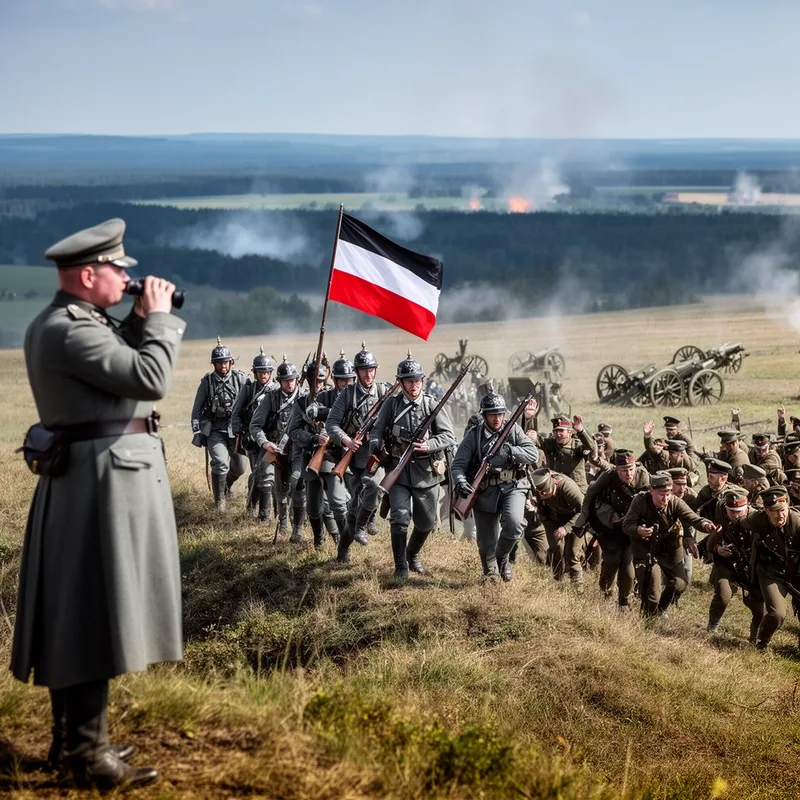
Battle of Tannenberg


 1
8.4
- proper noun
- Many historians consider the Battle of Tannenberg crucial for Germany's early success.
Examples
-
History students often study the significance of the Battle of Tannenberg in World War I.
-
The Battle of Tannenberg was a turning point in World War I.
-
German military strategy was demonstrated at the Battle of Tannenberg.
-
The Battle of Tannenberg was a turning point on the Eastern Front in 1914.
-
The Battle of Tannenberg marked a significant turning point as German forces achieved a decisive victory over the Russians.
-
Many historians consider the Battle of Tannenberg to be one of the most important battles of World War I.
-
During the Battle of Tannenberg, German troops skillfully encircled the Russian army, leading to a crushing defeat for their opponents.
Synonyms
 1
9.9
A major 1914 World War I battle where Germany defeated the Russian army in East Prussia
Surface Forms
Morphology
battle + of + Tannenberg
The construction 'Battle of Tannenberg' is compositionally built from 'battle' + 'of' + a place name, so a learner who knows the constituents will understand it refers to a battle that took place at Tannenberg. However, the phrase names a specific historical event (date, outcome, significance) whose detailed meaning (1914, decisive German victory) cannot be derived from the words alone, so full interpretation requires prior knowledge.
Etymology
The Battle of Tannenberg is named after the place Tannenberg, which in German means 'fir hill', so picture a fight near a hill of fir trees. It was a major 1914 World War I battle where German troops beat Russian forces, so the name now reminds people of that clear German victory.