
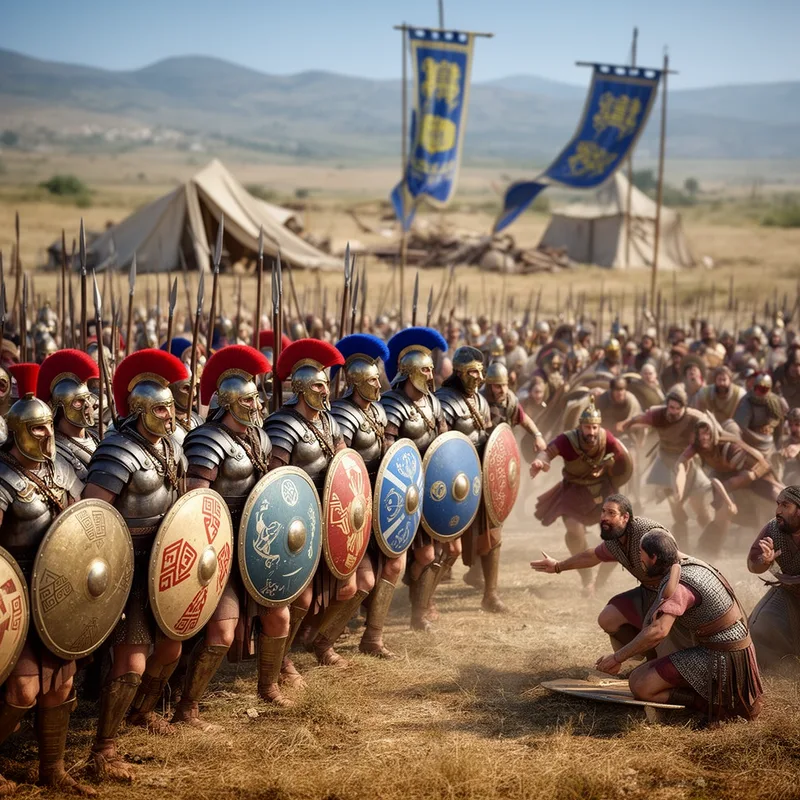
Battle of Plataea


 1
8.2
- proper noun
- The Battle of Plataea in 479 BC is considered a significant event that ended the Persian invasion of Greece.
Examples
-
The Battle of Plataea marked the end of the Persian Wars in ancient Greece.
-
During the Battle of Plataea, Greek forces united to achieve a decisive victory.
-
Historians often cite the Battle of Plataea as a turning point in Western history.
-
The Battle of Plataea was a turning point in Greek history.
-
Did the Battle of Plataea really end the Persian invasion?
-
During the Battle of Plataea, Greek forces united to achieve a decisive victory over the Persians.
-
Historians regard the Battle of Plataea as a crucial moment that shaped the future of Western civilization.
Surface Forms
Morphology
The phrase is fully compositional: 'battle' (large armed fight) combined with the place name 'Plataea' clearly denotes a battle that took place at Plataea, so a B1 learner who knows the parts will infer it refers to that specific engagement. Although learners may not know the historical date or significance, the referential meaning is directly derivable and follows the common 'Battle of X' naming pattern found across languages.
Etymology
Battle of Plataea took place near the town of Plataea in Greece in 479 BC, when several Greek city-states joined forces and defeated the Persian army. Because the Greeks stopped the invasion there, the name is remembered as the place that ended the Persian Wars and as a 'turning point' in history.