
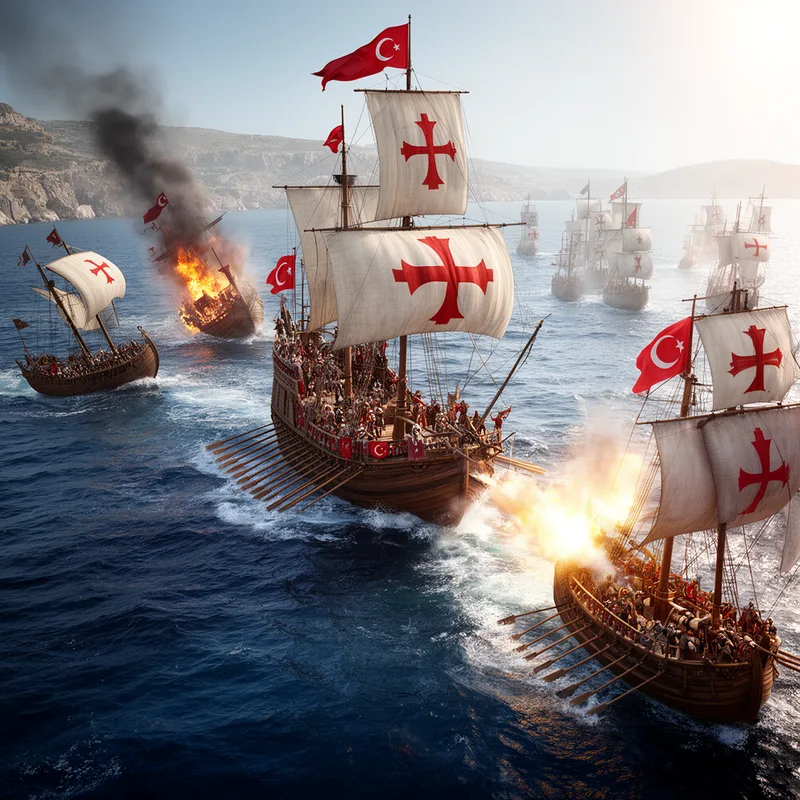
Battle of Lepanto


 1
9.9
- proper noun
- /ˈbætəl əv ləˈpæntoʊ/
- Many historians regard the Battle of Lepanto as a significant turning point, marking the decline of Ottoman naval power in the Mediterranean.
- the Battle of Lepanto in 1571
Examples
-
From its defeat by a Christian fleet at the Battle of Lepanto in 1571, to its failure to capture Vienna in 1683, to its final disappearance after World War I, the Ottoman Empire slowly shrank into oblivion.
Academic text (2007) -
Sorolla's commissioned nineteenth-century paintings in the grand academic style hang today in the Spanish Senado, where Luna's Battle of Lepanto also hangs.
Academic text (2015) -
Both slaves bring to mind the captive in Titian's Allegory of the Battle of Lepanto (Fig. 19), an unambiguous representation of a Turkish prisoner.
Academic text (2015) -
The Battle of Lepanto in 1571 was a pivotal moment in European history, where the Holy League defeated the Ottoman Empire.
-
Artists have depicted the Battle of Lepanto, showcasing the fierce naval confrontations of the 16th century.
Synonyms
 1
9.9
A sea battle in 1571 where Christian states defeated the Turkish navy
Surface Forms
Morphology
The phrase is compositionally built from 'battle' + 'of' + a place name, so a learner who knows the words will understand it denotes a battle that took place at Lepanto. This noun-of-toponym construction is cross-linguistically common and transparent, even though specific historical details (date, belligerents) are not derivable from the words alone.
Etymology
Battle of Lepanto was a great sea fight near the town of Lepanto in 1571 when a Christian fleet beat the Ottoman navy. Because this victory stopped Ottoman control of the sea, the name is used as a strong 'turning point' in Mediterranean power.