
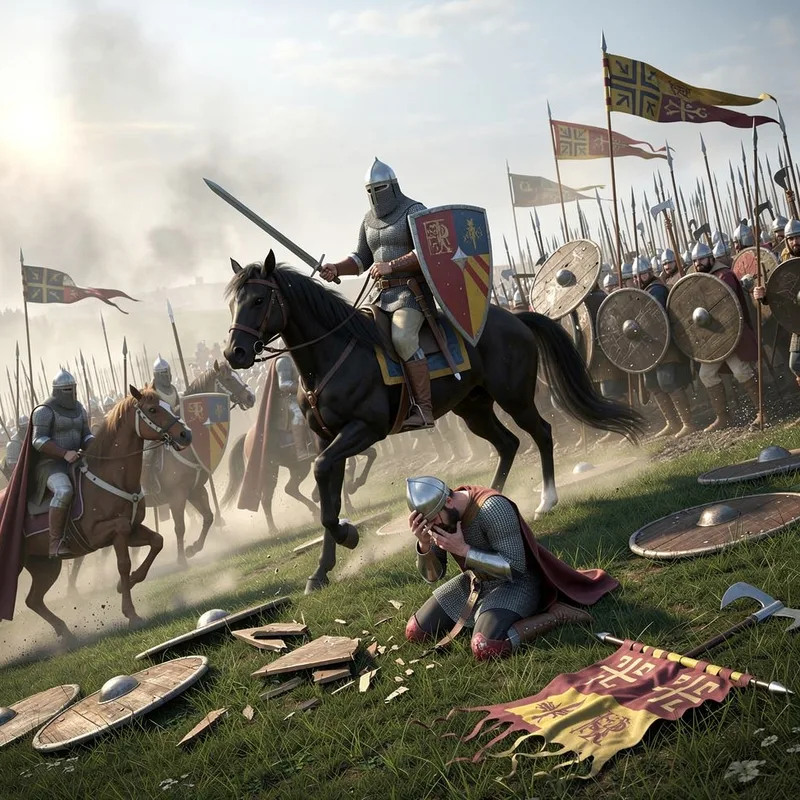
Battle of Hastings
 1
4.9
1
4.9

- noun
- I did read, recently, about the Battle of Hastings reassessment and the potential finds there once they start digging up that trench.
Examples
-
The Battle of Hastings was fought on this day back in 1066.
-
The Battle of Hastings was fought on this day back in 1066.
Blog text (4) -
And in other ancient news: the Battle of Hastings may well have been mislocated by a country mile for 950 years.
Blog text (19) -
The debate on whether there was indeed a feigned retreat of William's cavalry at the second stage of the battle of Hastings has been fought almost as hard as the battle itself, and we need not engage in this issue.
Academic text (2010) -
On Oct. 14, 1066, the Norman-French army defeated the English at the Battle of Hastings.
-
After William the Conqueror defeated King Harold II at the Battle of Hastings, England experienced significant changes.
Synonyms

A 1066 battle in which William of Normandy defeats the English army
Surface Forms
Morphology
The phrase follows the fully compositional pattern 'battle of X' meaning 'a battle that took place at X'; a B1 learner who knows 'battle' and recognizes 'Hastings' as a place/name will readily infer it refers to a battle at Hastings. This place‑name construction is common cross‑linguistically, so the overall meaning is predictable from the constituents even if the learner lacks the historical details.
Etymology
The name Battle of Hastings comes from a real fight near the town of Hastings in 1066, when William the Conqueror came from Normandy and defeated King Harold. That win let the Normans 'take control' of England, so the phrase points to a 'major change' in English history.