
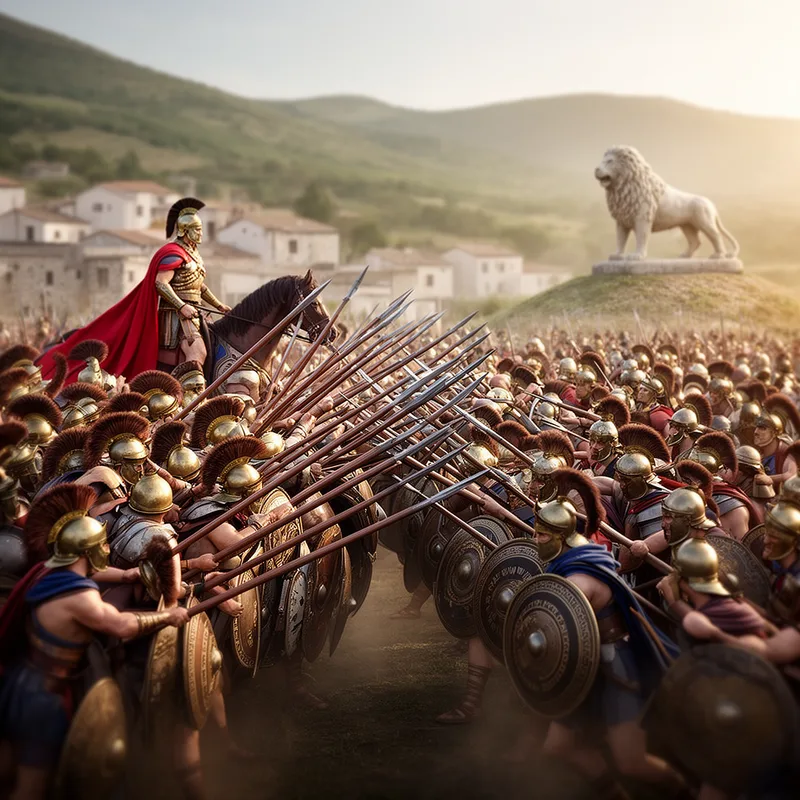
Battle of Chaeronea
- proper noun
- Did you know the Battle of Chaeronea took place in 338 BC?
Examples
-
The Battle of Chaeronea was a significant event where Philip II defeated the Greek forces of Athens and Thebes.
-
Historians study the Battle of Chaeronea to understand Philip II's military tactics.
-
The Battle of Chaeronea marked the end of Greek city-state independence.
-
The monument at the site of the Battle of Chaeronea attracts many visitors each year.
-
The Battle of Chaeronea was a turning point in Greek history.
-
After the Battle of Chaeronea, the power dynamics in ancient Greece dramatically changed.
-
Many historians regard the Battle of Chaeronea as a pivotal moment in the rise of Macedonian power.
Synonyms



 1
9.9
1
9.9
An ancient Greek town known for important battles, for example in 338 BC and 86 BC
Surface Forms
Morphology
The phrase is directly compositional: 'battle' + 'of' + the place name indicates a military engagement that took place at Chaeronea, so a learner who knows the words will understand it denotes a battle at that location. Although historical details (date, belligerents) are not given by the constituents, the core meaning is transparent and follows a common cross-linguistic pattern for naming battles.
Etymology
Battle of Chaeronea was fought in 338 BC near Chaeronea when Philip II of Macedonia defeated the armies of Athens and Thebes and took control of many Greek city-states. Because his win made those cities 'lose their independence', the name Battle of Chaeronea now stands for that major change in Greek history.