
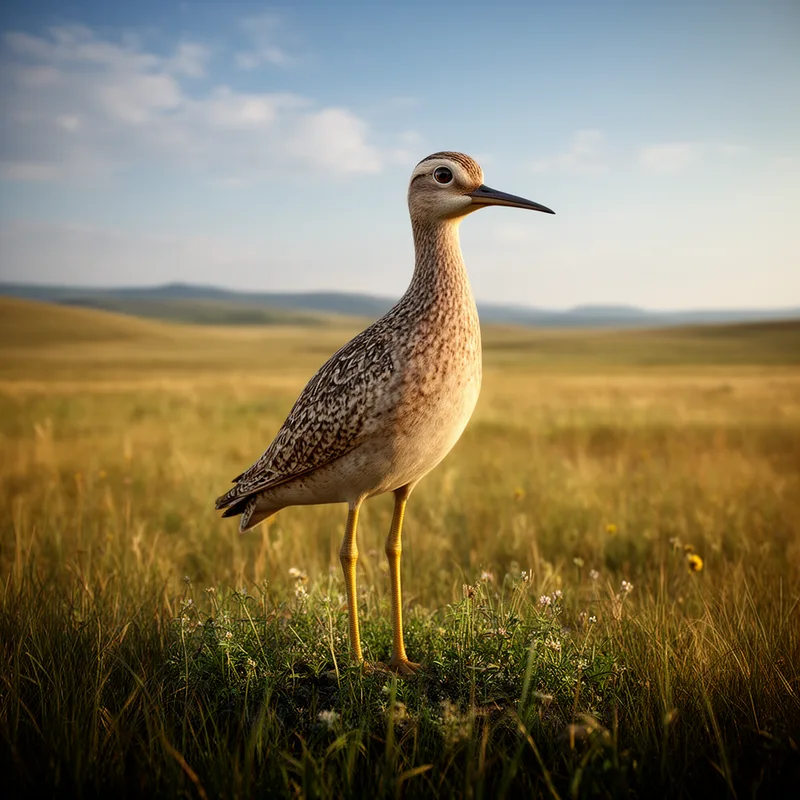
Bartramia longicauda
- noun
- Specialized
- Unlike many shorebirds, the Bartramia longicauda prefers upland habitats far from the coast.
Examples
-
The Bartramia longicauda can often be found in grasslands during the breeding season.
-
The Bartramia longicauda can often be seen in open fields.
-
Researchers observed several Bartramia longicauda in the conservation area last spring.
-
Have you spotted a Bartramia longicauda in the area?
-
Researchers observed several Bartramia longicauda in the conservation area last spring.
-
The Bartramia longicauda can often be found in grasslands during the breeding season.
-
Unlike many shorebirds, the Bartramia longicauda prefers upland habitats far from the coast.
Synonyms

A large bird like a plover that lives in North American fields and meadows
A large bird with a long neck and yellow legs that lives in open fields and grasslands

A large brown bird with long legs that lives in open North American fields
Surface Forms
Morphology
Bartramia + longicauda
This is a Latin binomial: 'Bartramia' names a bird genus (so a learner who knows that would know it refers to a kind of bird), but 'longicauda' is a non‑English Latin epithet (not in a learner dictionary) and is unlikely to be recognised by a B1 learner. The combination therefore gives some clue (a particular species of Bartramia) but the precise meaning 'upland sandpiper' or the sense of the epithet is not directly derivable without specialist or Latin knowledge.
Etymology
Bartramia longicauda is a name made of two parts: Bartramia 'after the naturalist William Bartram' and longicauda 'long tail'. That helps you remember that this upland sandpiper was named for Bartram and is known for its long tail.

