
Aurignacian


 1
9.9
- noun
- /ɔːˈrɪnˌkeɪ.ən/
- Specialized
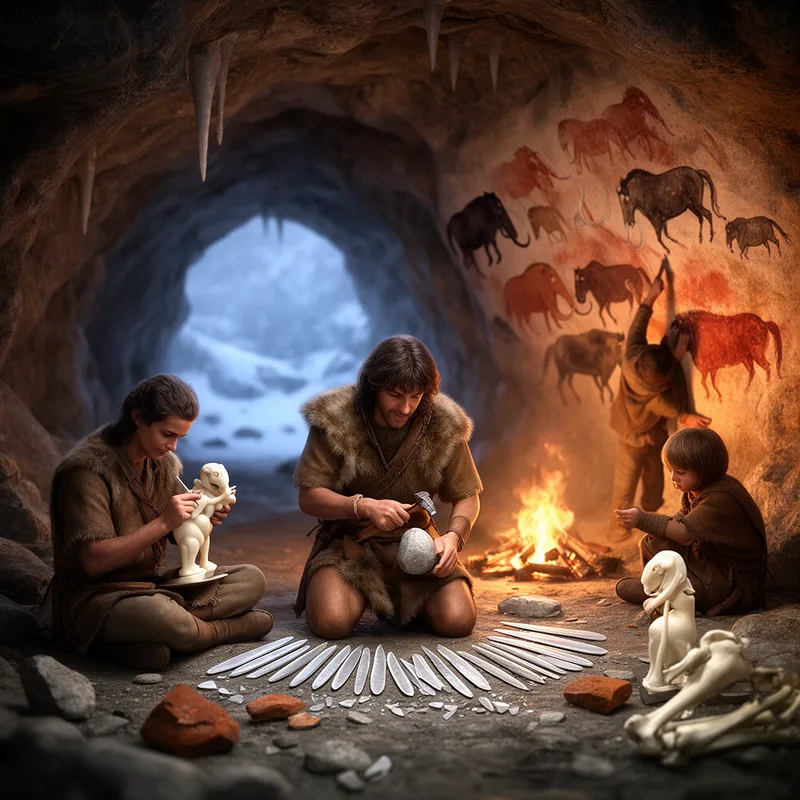
- Artifacts from the Aurignacian period include advanced tools and decorative ornaments found in caves.
Examples
-
I expect a working mathematically formal model to justify how something that appears to be a few thousand years old by every method known to man actually goes back tens of thousands of years to the Aurignacian.
Blog text (11) -
Meanwhile, artifacts from the Middle Paleolithic layers came back with dates thousands of years younger than pieces from the Aurignacian.
Academic text (2007) -
"The Aurignacian developed here, the Gravettian developed here," he says now.
Academic text (2007) -
About four feet higher, a sheet labeled "Aurignacian" modestly marks a critical shift in human history.
Academic text (2007) -
"That's certainly the case with the Aurignacian in Swabia.
Academic text (2007) -
At the moment, R-M269 is dated well after the Aurignacian with either the best Y-STRs or with Y-SNPs, and it has not been found in any European before the Bronze Age.
Blog text (11) -
The Aurignacian culture is famous for its intricate stone tools and examples of early art.
-
Researchers believe that the Aurignacian people were among the first to create symbolic art in Europe.
Surface Forms
Morphology
Aurignacian = Aurignac (opaque) = Aurignac + ian
Formed from the place-name 'Aurignac' + '-ian' to designate a specific archaeological culture; the base is obscure and the meaning is specialist.
Etymology
Aurignacian names a prehistoric culture and comes from the French village Aurignac with the ending -ian, which means 'from' or 'related to', like Victorian. So the Aurignacian period is the time and culture tied to the finds near Aurignac, known for early modern human tools and art.