
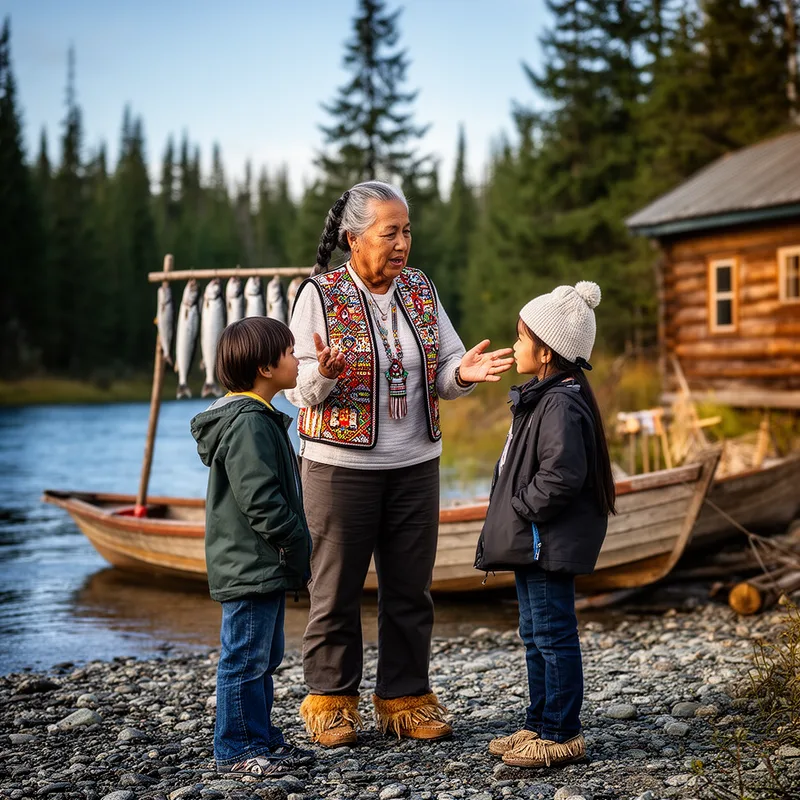
Athabascan
- noun
- /ˌæθəˈbæskən/
- Brace and Tracer (1993) have proposed that, instead of a single migration before that of the Athabascan-speaking peoples, there were at least two populations present in the Americas prior to the Athabascans.
- Athabascan Indian
- Athabascan Indians
- Athabascan people
Examples
-
The Athabascan Way of Death
Fiction book (2002) -
In my years in the Tanana Valley, I learned to respect very much the burial customs of the Athabascan people.
Fiction book (2002) -
I think you mean to say "Athabascan."
-
Clothes made by the Athabascan people were often, through the use of beads and fur, works of art.
Fiction book (2002) -
At that time, only anthropologists called them Athabascan Indians.
Fiction book (2002) -
Both are populated by Athabascan Indians who belong to the Royukon-speaking linguistic group.
Academic text (1994) -
Along the river are many small Yup'ik Eskimo and Athabascan Indian villages.
Fiction book (2001) -
These Athabascan people kept their nomadic hunter-gatherer lifestyle for the next 100 years, living in wikiups.
Academic text (2009) -
Three of the five students (Paul, Oscar, and Ellie) lived in native Alaskan villages (e.g., Athabascan, Yupik, and Tlingit).
Academic text (2006) -
Many Athabascan people have preserved their traditional lifestyles despite modern influences.
Synonyms


 1
7.3
1
7.3
A person whose family comes from the native peoples of North or South America
A Native American person who speaks a related western North American language, often living in Alaska or Canada

A person from Indigenous groups in Alaska or western Canada who speaks related native languages
A person from native groups in western Canada or central Alaska who speak similar languages
Surface Forms
Morphology
Athabascan = Athabasca (transparent) = Athabasca + an
Formed by adding the demonym/language-forming suffix '-an' to the place name 'Athabasca', so the derivation is straightforward if the base is known.
Etymology
Athabascan for the people comes from the place name Athabasca, a river and lake in Canada. That place name comes from a local native word meaning 'where there are reeds', so the name links the people to the river region where they live.