
Aspidelaps lubricus
- noun
- Specialized
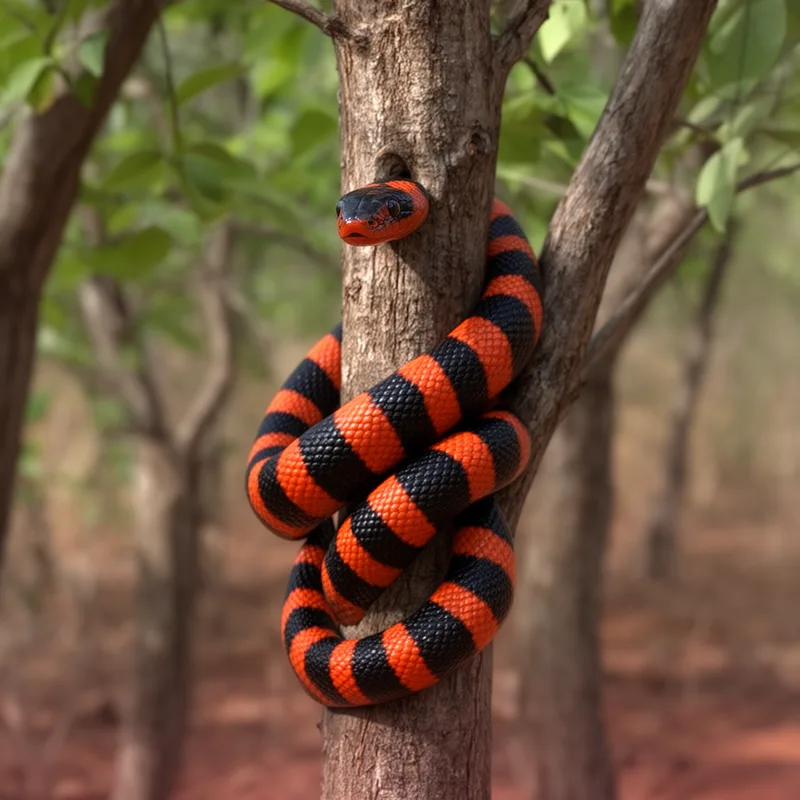
- The Aspidelaps lubricus can be found climbing trees in the southern African forests.
Examples
-
The brightly colored Aspidelaps lubricus is often mistaken for more dangerous snakes due to its vivid bands.
-
Researchers discovered several Aspidelaps lubricus specimens in the woodlands during their survey.
-
Because of its coloration, Aspidelaps lubricus can be spotted easily in its natural habitat.
-
The Aspidelaps lubricus is known for its striking colors.
-
Have you ever seen an Aspidelaps lubricus in the wild?
-
Many photographers travel to capture images of the beautiful Aspidelaps lubricus in its natural environment.
-
Due to its attractive black and orange bands, the Aspidelaps lubricus is a popular subject in wildlife documentaries.
Synonyms

 2
7.2
2
7.2

A small venomous snake with red, yellow, and black bands that has a deadly bite

A small snake that lives in trees in southern Africa with black and orange bands
Surface Forms
Morphology
Aspidelaps + lubricus
This is a Latin scientific binomial (genus + species) functioning as a proper name for a specific snake; its meaning is referential rather than compositionally derived from English words. The second element 'lubricus' is not an English lemma here and even knowing 'Aspidelaps' would not allow a B1 learner to infer the descriptive species meaning, so the expression is opaque.
Etymology
Aspidelaps lubricus likely comes from old Greek and Latin words: aspis meaning 'shield' for the snake's rounded head scales, and lubricus meaning 'slippery' for its smooth, shiny skin. So the name paints the image of a small 'slippery shield' snake, which helps explain why it fits this banded, cobra-like species from southern Africa.