
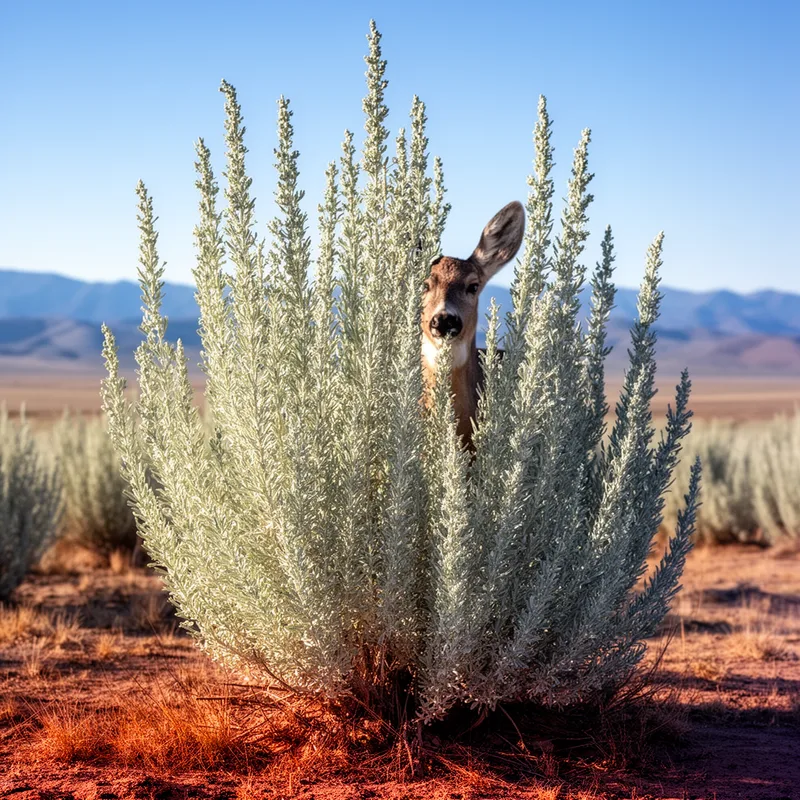
Artemisia tridentata
- noun
- /ˌɑːrtəˈmɪziə traɪˈdɛnteɪtə/
- Specialized
- The vast plains were covered with Artemisia tridentata, filling the air with its distinctive scent.
Examples
-
The vast plains of the Great Basin are often dominated by Artemisia tridentata, which provides essential habitat for wildlife.
-
Researchers studied the resilience of Artemisia tridentata to prolonged drought conditions in the desert.
-
Many animals in the Great Basin rely on Artemisia tridentata as an important source of food and shelter.
-
The Artemisia tridentata grows abundantly in the Great Basin.
-
Many animals rely on Artemisia tridentata for food.
-
During the summer, the silvery-grey leaves of Artemisia tridentata release a strong aroma that is characteristic of the desert landscape.
-
Researchers have discovered that Artemisia tridentata plays a crucial role in preventing soil erosion in arid environments.
Synonyms
 8
7.7
8
7.7

A woody bush with grey leaves and a strong smell that grows in dry areas

A large shrub with a strong smell and silvery grey leaves that grows in dry parts of western North America
Surface Forms
Morphology
Artemisia + tridentata
This is a scientific Latin binomial rather than a compositional English phrase: a B1 learner who knows the English words given would not be able to derive the common meaning 'big sagebrush' from 'Artemisia' (a genus name) and the opaque epithet 'tridentata' (not a standard English word). Even if learners recognize Latin roots (tri- / dent-), that morphological insight would not reliably yield the species identity or everyday meaning, so the expression functions as an arbitrary label.
Etymology
Artemisia tridentata comes from two parts: Artemisia, a name linked to the Greek goddess Artemis, and tridentata, which means 'three-toothed' and points to the plant's three-lobed leaves. This image of a silvery, strongly scented shrub with three-part leaves helps explain why the name refers to the common 'big sagebrush' found in dry western North America.