

Anadenanthera colubrina
- noun
- Specialized
- The Anadenanthera colubrina tree produces pods that contain psychoactive compounds.
Examples
-
The Anadenanthera colubrina tree thrives in tropical climates.
-
Researchers study Anadenanthera colubrina for its medicinal and ecological value.
-
Many indigenous groups in Brazil use the seeds of Anadenanthera colubrina in traditional ceremonies.
-
Many herbalists use Anadenanthera colubrina for its medicinal properties.
-
Many indigenous groups in Brazil use the seeds of Anadenanthera colubrina in traditional ceremonies.
-
Researchers study Anadenanthera colubrina for its medicinal and ecological value.
-
The Anadenanthera colubrina tree produces pods that contain psychoactive compounds.
Synonyms
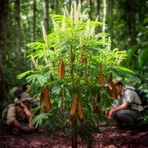
A Brazilian shrub with divided leaves, small flower spikes, and flat seed pods
Surface Forms
Morphology
Both constituents are botanical genus names referring to shrubs or trees, so a learner who knows those definitions could plausibly infer that Anadenanthera colubrina denotes a plant (a tree or shrub). However, the precise species identity, morphological details and the conventions of Latin binomial naming are domain-specific and not fully predictable for a B1 learner, so the meaning is only partially recoverable.
Etymology
Anadenanthera colubrina may come from Greek and Latin words that describe the tree. The first part, Anadenanthera, points to the flower's pollen part ('anther'), and the second part, colubrina, means 'snake-like' — think of the tree's long, snake-like pods, which helps explain the name.

