
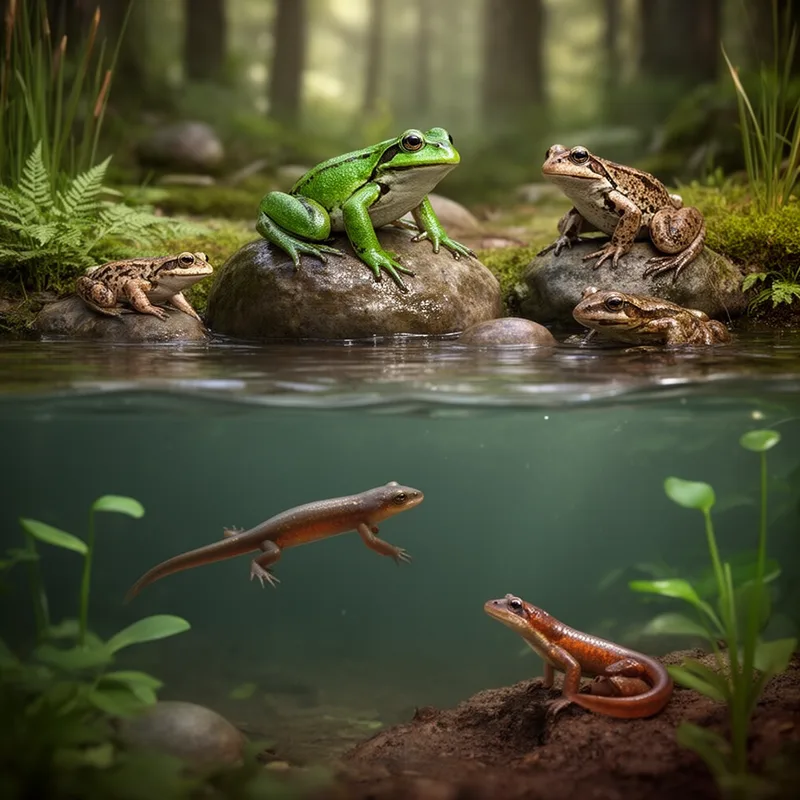
Amphibia
- noun
- /æmˈfɪbiə/
- Specialized
- Certain amphibians have their tongues rooted to the front of their mouths.
Loading YouTube…
Watch on YouTubeSo those are fish, amphibians, reptiles, birds, and mammal.
- So those are fish, amphibians, reptiles, birds, and mammal.
- If you look at amphibians and reptiles, they don't have a diaphragm, and the way they breathe is not by actively inspiring and passively expiring.
- And for example, the fish and the amphibians.
Examples
-
So those are fish, amphibians, reptiles, birds, and mammal.
-
Keywords: Amphibia; biodiversity; extinction; Red List; taxonomy
Academic text (2010) -
But it turns out that in amphibians they have the same problem.
-
Even if the loss of hall of the class Amphibia is something we think we can live with, shouldn't we be a little more concerned for ourselves?
Academic text (2007) -
So I'm suddenly surrounded by people who can answer all my questions about the mammals and the birds and the reptiles, the amphibians, the insects, the plants.
-
So I'm suddenly surrounded by people who can answer all my questions about the mammals and the birds and the reptiles, the amphibians, the insects, the plants.
-
Frame was a collection of fish, crustaceans, octopods, and amphibians, all carved beautifully out of a spectral white gold.
-
That's I thought toads never went weren't technically amphibians and frogs were?
-
If you look at amphibians and reptiles, they don't have a diaphragm, and the way they breathe is not by actively inspiring and passively expiring.
-
Frogs and toads are both examples of amphibia, as they can live both on land and in water during different stages of their lives.
Synonyms
 21
4.4
21
4.4

A cold-blooded animal that lives on land and in water, like a frog
Compounds
- Specialized
A plant with small yellow flowers that lives for many years by rivers
Surface Forms
Etymology
Amphibia comes from Greek parts amphi- 'both' and -bios 'life', the same 'bio' you see in biology. So Amphibia are animals that live 'both' on land and in water, like frogs and salamanders.