

Amorpha canescens
- noun
- Specialized
- Many prairie restoration projects make use of Amorpha canescens for its hardiness and soil-improving properties.
Examples
-
Botanists observed Amorpha canescens thriving along the sandy banks after last season's flood.
-
Some miners once believed that finding Amorpha canescens in an area signaled the presence of lead ore underground.
-
The Amorpha canescens thrives in sandy woodlands.
-
Look at that beautiful Amorpha canescens!
-
Botanists observed Amorpha canescens thriving along the sandy banks after last season's flood.
-
Many prairie restoration projects make use of Amorpha canescens for its hardiness and soil-improving properties.
-
Some miners once believed that finding Amorpha canescens in an area signaled the presence of lead ore underground.
Synonyms
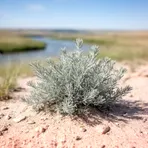
A low bush with grey divided leaves that grows in sandy soils

A shrub that grows on sandy river banks and is thought to show nearby lead
Surface Forms
Morphology
Amorpha + canescens
This is a Linnaean binomial (a Latin scientific name) functioning as a proper taxonomic label rather than a compositional phrase; a B1 learner who knows the genus name but not the Latin epithet cannot derive the shrub description. The specific epithet 'canescens' is Latin (meaning roughly 'becoming gray') and is specialized knowledge, so the overall meaning is not transparently predictable from the constituents for a typical B1 learner.
Etymology
Amorpha canescens comes from old languages: Amorpha means 'without shape' because its small flowers look plain, and canescens means 'becoming grey' for its gray, fuzzy leaves. So the name helps you picture a gray-leaved shrub with simple flowers, the hardy 'leadplant' often found on sandy banks.

