
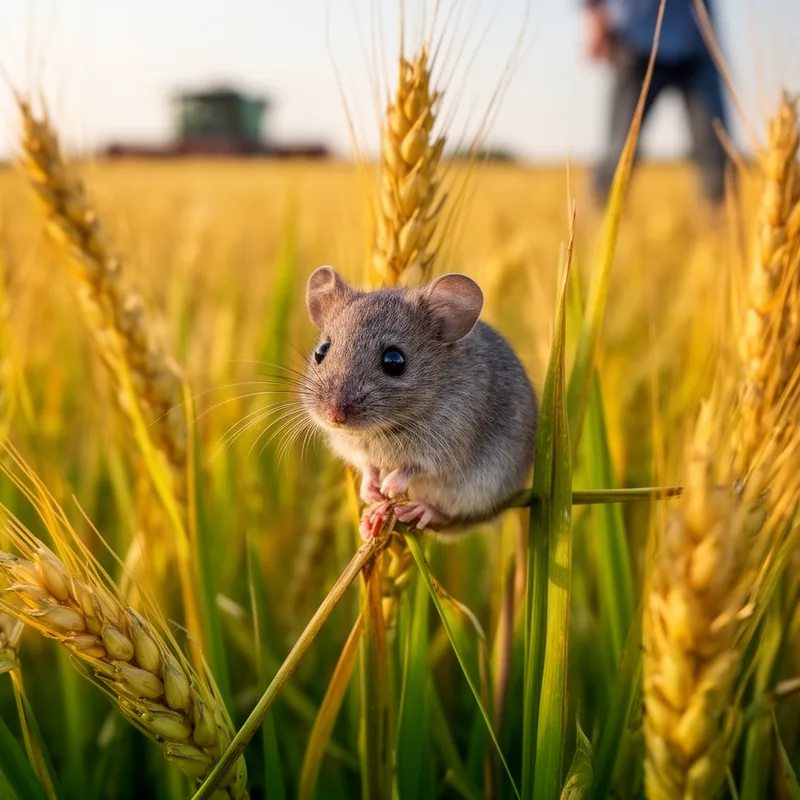
American harvest mouse
- noun
- /əˈmɛrɪkən ˈhɑrvɪst maʊs/
- US
- The American harvest mouse is rarely seen during the day as it hides in tall grass.
Examples
-
Researchers discovered a nest of American harvest mice in the abandoned field.
-
Researchers discovered a nest of American harvest mice hidden among the tall grasses of an abandoned field.
-
Farmers often encounter the American harvest mouse when harvesting grains.
-
The American harvest mouse is often found in fields.
-
Many American harvest mice live in grassy areas.
-
Farmers often encounter the American harvest mouse when they are harvesting grains in the fields.
-
The American harvest mouse prefers to stay hidden during the day, usually resting in the safety of dense grass.
Synonyms

 587
1.0
587
1.0

A small animal with a pointed nose, small ears, and a long tail
 4
2.1
4
2.1
A small wild mouse that lives in fields or meadows


 1
4.4
1
4.4
A small mouse that lives in fields and climbs tall grasses
Surface Forms
Morphology
The phrase is fully compositional: 'harvest mouse' describes a mouse associated with harvests/fields and 'American' localizes it to the Americas. A B1 learner who knows the three words would readily infer this refers to a small mouse found in grain fields in America, since this naming pattern is transparent and cross-linguistically common.
Etymology
The name American harvest mouse comes from tiny mice people find in grain fields when farmers gather crops. Harvest points to those fields and American shows they live in North and Central America, so the name means a 'field mouse' from America.