
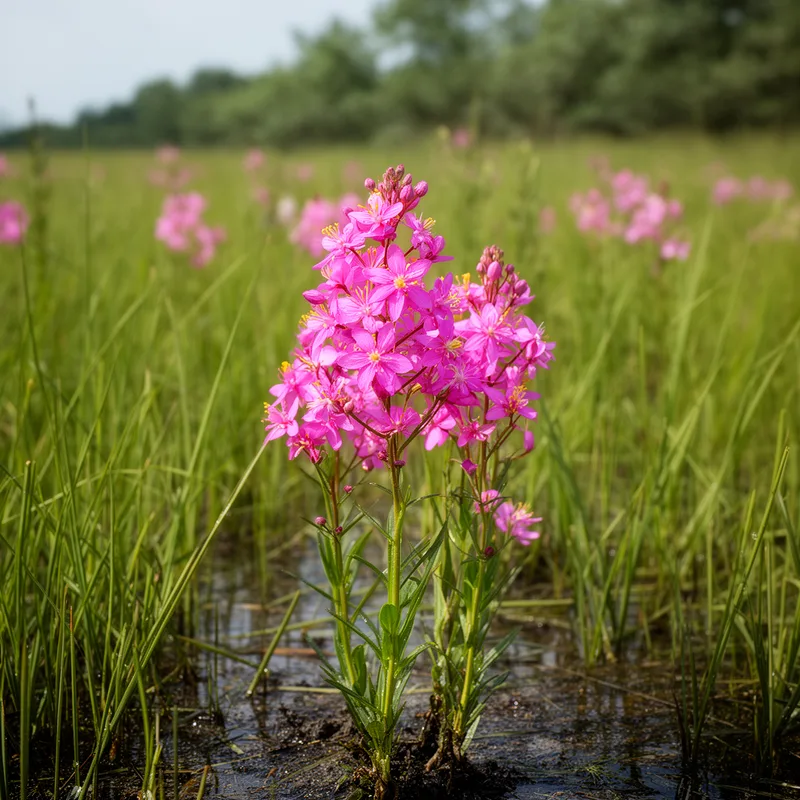
American centaury
- noun
- /əˈmɛrɪkən ˈsɛnˌtɔri/
- US
- The marsh was populated with clusters of American centaury blooming among the grasses.
Examples
-
Gardeners have started cultivating American centaury as an attractive wildflower in native plant gardens.
-
Botanists surveyed the area and found several specimens of American centaury near the shoreline.
-
The American centaury blooms beautifully in spring.
-
Have you seen the American centaury in the garden?
-
Along the wetland trail, we spotted vibrant clusters of American centaury blossoming in the sunshine.
-
In the eastern United States, the American centaury is renowned for its striking pink flowers that attract many pollinators.
-
The nature reserve is home to many native plants, including the delicate American centaury which thrives near water.
Synonyms


 1
8.7
1
8.7
A marsh plant with bright pink flowers that attracts insects

A marsh plant with pink flowers that grows in wet places in the eastern United States
A marsh plant with pink flowers that grows in the eastern United States
A plant with pink flowers that grows in wet marshes
Surface Forms
Morphology
The phrase is an adjectival modifier + noun: 'American' (from the United States) + 'centaury' (a small pink-flowered plant), so the meaning—a centaury native to America—is directly derivable from the parts. This straightforward compositional pattern is cross-linguistically common and would be understandable to a B1 learner who knows both constituents.
Etymology
American centaury gets its name from the older plant name centaury, which comes from a story about a wise centaur who used wild plants to heal people. When a similar pink marsh plant was found in America, people called it American centaury because it looked like the original, so the name shows it is a similar, 'healing' kind of plant.