

American bison


 1
3.3
1
3.3
- noun
- /əˈmɛrɪkən ˈbaɪsən/
- Specialized
- herds of American bison
Examples
-
It is named for the American bison, which may well have grazed there when it roamed this part of Ohio.
Academic text (1991) -
A herd of 370 American bison searching for native prairie grasses to eat often finds noxious weeds instead.
Academic text (1994) -
Sanderson EW, et al. 2008. The ecological future of the North American bison: Conceiving long-term, large-scale conservation of wildlife. Conservation Biology 22: 252-266.
Academic text (2011) -
During our trip to Yellowstone National Park, we saw a herd of American bison grazing peacefully in the meadows.
-
The American bison is an important symbol of the American West and plays a key role in Native American culture.
-
Many conservationists are working to increase the population of American bison to restore the ecosystem of the Great Plains.
Synonyms
 32
3.9
32
3.9
A large wild animal like a cow with a humped back, thick fur, and short horns
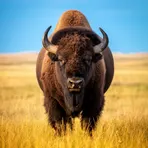 28
1.7
28
1.7
A large wild animal with shaggy hair from North America often called bison or its meat used as food
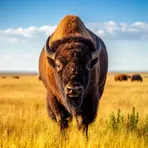
A large, shaggy brown bison that lives on the North American plains
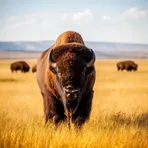
A large brown wild animal with thick fur that lives on North American plains
Surface Forms
Morphology
The meaning 'a bison native to North America' is directly and compositionally derived from combining the adjective 'American' (denoting origin) with the noun 'bison' (the animal). This attributive adjective + noun pattern is a common, cross-linguistic way to mark origin or type, so a B1 learner who knows both constituents will readily understand the phrase.
Etymology
American bison names the large, shaggy bison that once roamed the wide grass plains of North America; early settlers often called them 'buffalo' and watched huge herds moving together. So the name brings to mind a strong, wild animal and explains why it is a symbol of the American West.