
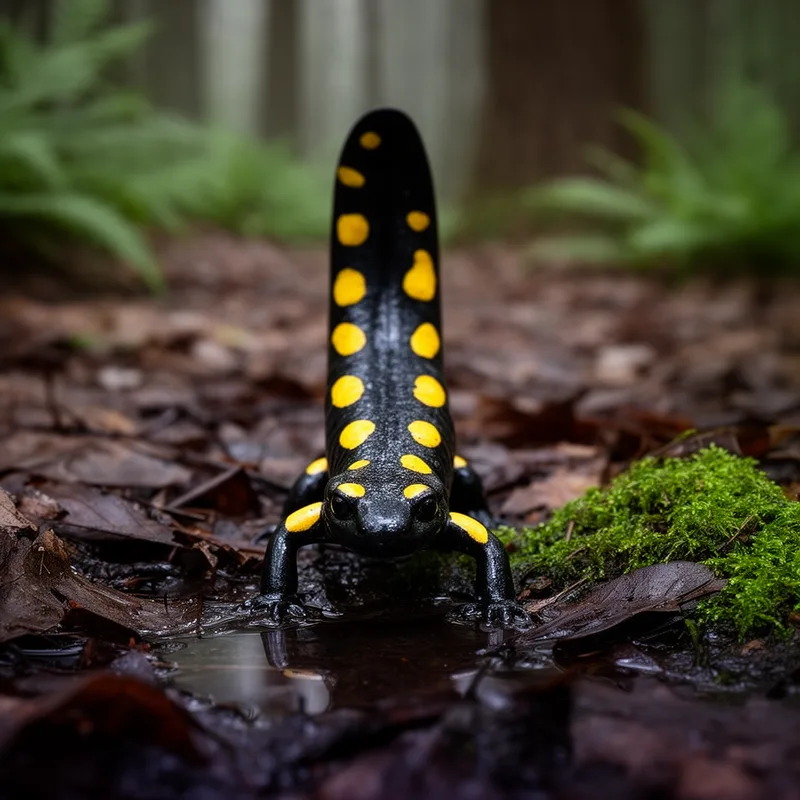
Ambystoma maculatum
- noun
- /æmˈbɪstəˌmoʊməˈkæljʊtəm/
- Specialized
- Because of habitat loss, the conservation status of Ambystoma maculatum has become a concern.
Examples
-
The Ambystoma maculatum is often found in moist, wooded areas.
-
Researchers discovered a healthy population of Ambystoma maculatum in the wooded wetlands.
-
The Ambystoma maculatum emerges from its burrow to breed in spring ponds.
-
Did you know that the Ambystoma maculatum has yellow spots?
-
The Ambystoma maculatum, known as the spotted salamander, is often seen in early spring near ponds.
-
During her hike, she was excited to spot an Ambystoma maculatum hiding under a leaf.
-
The Ambystoma maculatum is easily identifiable by its distinctive yellow spots against a dark background.
Synonyms


 1
6.4
1
6.4
A dark small animal with yellow or orange spots that lives near ponds in North America
Surface Forms
Morphology
Ambystoma + maculatum
This is a Latin scientific binomial (genus + species) rather than a compositional English phrase, and the constituents given are taxonomic labels not ordinary English words; 'maculatum' is not defined here. Even if 'maculatum' etymologically means 'spotted', that knowledge is specialized and not available to an average B1 learner, so the meaning 'spotted salamander' cannot be derived from the parts. Therefore the expression is idiomatic/technical and not transparently interpretable by learners.
Etymology
Ambystoma maculatum comes from old Greek and Latin words: Ambystoma means 'blunt mouth' and maculatum means 'spotted'. So the name paints a picture of the dark salamander with yellow spots, which is why we call it the 'spotted salamander'.