
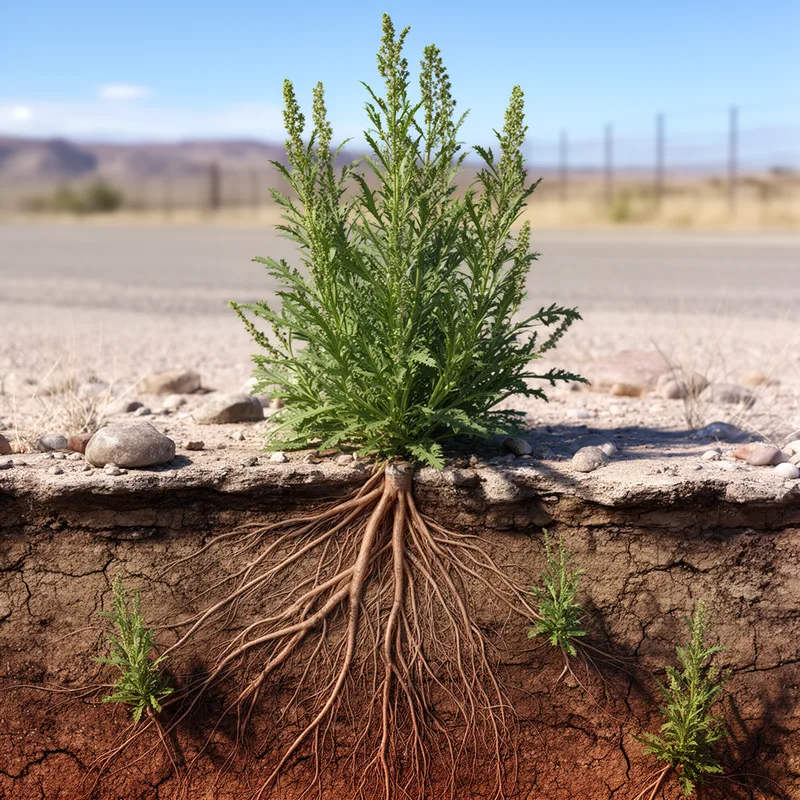
Ambrosia psilostachya
- noun
- Specialized
- The deep roots of Ambrosia psilostachya help it survive in dry, nutrient-poor soils.
Examples
-
Gardeners may try to remove Ambrosia psilostachya because of its aggressive spreading habit.
-
Ambrosia psilostachya is commonly found along roadsides in arid regions of the southwest.
-
The Ambrosia psilostachya thrives in arid environments.
-
Many gardeners avoid Ambrosia psilostachya due to its invasive nature.
-
Ambrosia psilostachya is commonly found along roadsides in arid regions of the southwest.
-
The deep roots of Ambrosia psilostachya help it survive in dry, nutrient-poor soils.
-
Gardeners may try to remove Ambrosia psilostachya because of its aggressive spreading habit.
Synonyms

A tough wild plant with creeping roots that grows in dry, rocky places in the US southwest and Mexico

A rough plant with spreading roots that lives year after year in dry open land
Surface Forms
Morphology
ambrosia + psilostachya
This is a scientific Latin binomial (genus + species). Even if a learner knows 'Ambrosia' as a ragweed genus, the species epithet 'psilostachya' is technical/opaque for a B1 learner and does not yield the specific meaning, so the overall phrase functions as a proper name rather than a compositional phrase.
Etymology
Ambrosia psilostachya may come from two old words: Ambrosia was 'food of the gods', a name for something that lasts, and psilostachya means 'smooth spike', a picture of its straight flower spikes. That's why the name fits this tough ragweed that lives a long time and spreads with creeping roots in dry places.

