
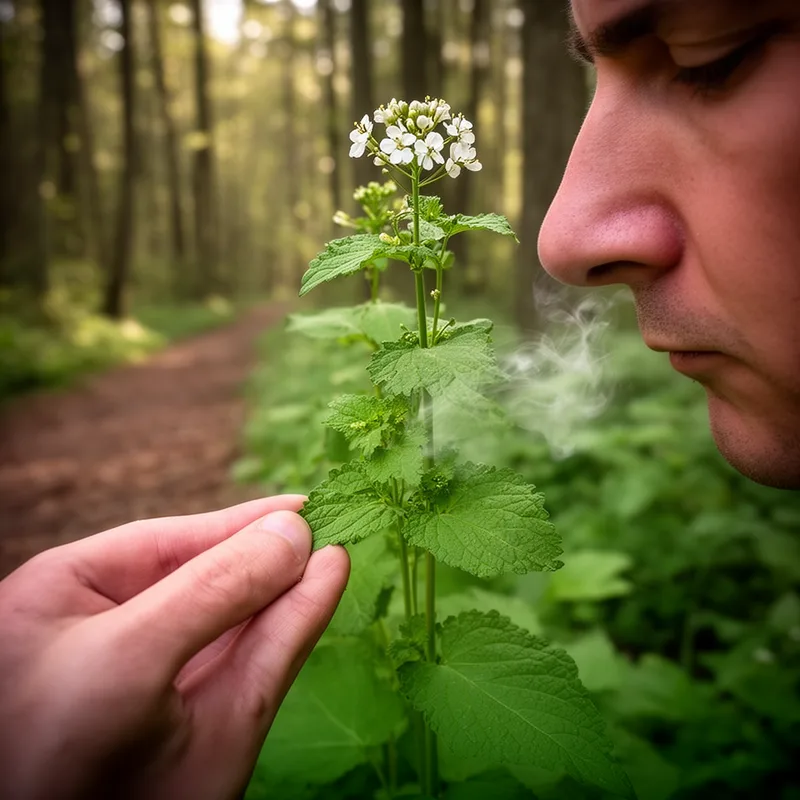
Alliaria officinalis
- noun
- Specialized
- The leaves of Alliaria officinalis emit a strong garlic scent when crushed.
Examples
-
Many chefs avoid using Alliaria officinalis because of its strong, garlic-like aroma.
-
Alliaria officinalis is commonly found along forest edges and shady pathways across Europe.
-
Researchers are studying the invasive potential of Alliaria officinalis in North American woodlands.
-
The Alliaria officinalis plant is often found in woodlands.
-
Have you ever tried Alliaria officinalis in your cooking?
-
Alliaria officinalis is often used in salads for its unique flavor, reminiscent of garlic.
-
Alliaria officinalis grows in moist, shady areas, making it common in woodland habitats.
Synonyms
A leafy herb with a mild garlic smell used in salads or cooking

A plant with green leaves that smell like garlic when crushed

A wild plant whose leaves smell like garlic when crushed
A wild plant with leaves that smell like garlic and can be eaten
Surface Forms
Morphology
This is a regular Latin binomial: the genus name 'Alliaria' identifies the plant group (garlic mustard) and the epithet 'officinalis' explicitly denotes medicinal use, so the combined meaning ('garlic mustard, a plant with acknowledged medicinal properties') is directly derivable from the parts. Botanical naming conventions are conventional and cross-linguistically consistent, making this compositional and predictable rather than idiomatic.
Etymology
Alliaria officinalis was named for two simple images: its leaves smell like garlic, and it belongs to the plant family called mustard, so people called it 'garlic mustard'. The Latin word 'officinalis' was an old label meaning 'used in medicine', so the full name points to a garlic‑smelling mustard once used as medicine.

