

Agave americana
- noun
- /əˈɡɑːveɪ əˈmɛrɪkənə/
- Specialized
- After blooming just once, the Agave americana plant typically dies, leaving behind new shoots.
Examples
-
The Agave americana produces a towering stalk when it finally blooms after many years.
-
Gardeners prize Agave americana for its striking, spiky leaves and dramatic flowering.
-
The Agave americana can grow up to 6 feet tall.
-
Look at the Agave americana!
-
After blooming just once, the Agave americana plant typically dies, leaving behind new shoots.
-
Gardeners prize Agave americana for its striking, spiky leaves and dramatic flowering.
-
The Agave americana produces a towering stalk when it finally blooms after many years.
Synonyms
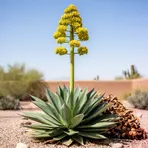
A large plant with thick leaves from the Americas that makes a tall flower stalk and blooms once before dying

A large plant with thick, sword-shaped leaves and a tall flower stalk
Surface Forms
Morphology
Agave + americana
This is a binomial scientific name composed of the genus 'Agave' and the epithet 'americana' (Latin for 'of/from the Americas'), so the meaning—an Agave species native to the Americas—is directly derivable from the parts. The compositional pattern of scientific names indicating taxon + origin is cross-linguistically regular, so a learner who knows both constituents can infer the referent without prior exposure.
Etymology
Agave americana is a big, spiky plant often called the 'century plant' because it stays as a low ring of sharp leaves for many years and then suddenly sends up one very tall flower stalk and dies. This dramatic image of a single, last bloom helps you remember it flowers only once in its life and then the main plant 'dies'.

