

Acer saccharum
- noun
- /ˈeɪsər ˈsækhərəm/
- Specialized
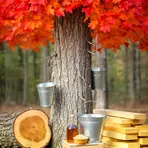
- Each spring, farmers tap Acer saccharum to collect the sap used in making maple syrup.
Examples
-
The hard wood of Acer saccharum is prized by furniture makers for its durability and attractive grain.
-
The dense forests of Vermont are known for the abundance of Acer saccharum, or sugar maple, trees.
-
The Acer saccharum is known for its beautiful fall foliage.
-
Many people enjoy the sweet syrup from Acer saccharum trees.
-
Every spring, farmers tap Acer saccharum to collect the sap used in making maple syrup.
-
The dense forests of Vermont are known for the abundance of Acer saccharum, or sugar maple, trees.
-
The hard wood of Acer saccharum is prized by furniture makers for its durability and attractive grain.
Synonyms
 4
3.6
4
3.6

A North American tree with hard wood and a sweet liquid used to make syrup and sugar

A large North American tree with hard wood used for furniture and sap used to make syrup
Surface Forms
Morphology
Acer + saccharum
This is a Latin binomial (scientific) name rather than a normal English phrase; the second element 'saccharum' is not a common English word (definition not provided), and 'Acer' as a genus label does not transparently equal 'maple' for a B1 learner. Even though the Latin root sacchar- relates to 'sugar', species names are not regular compositional English expressions, so the overall meaning ('sugar maple') would not be reliably derivable by an average B1 learner.
Etymology
Acer saccharum comes from Latin words Acer meaning 'maple' and saccharum meaning 'sugar'. People tap its sweet sap each spring to make maple syrup and sugar, so the name explains why we call it the 'sugar maple' today.