
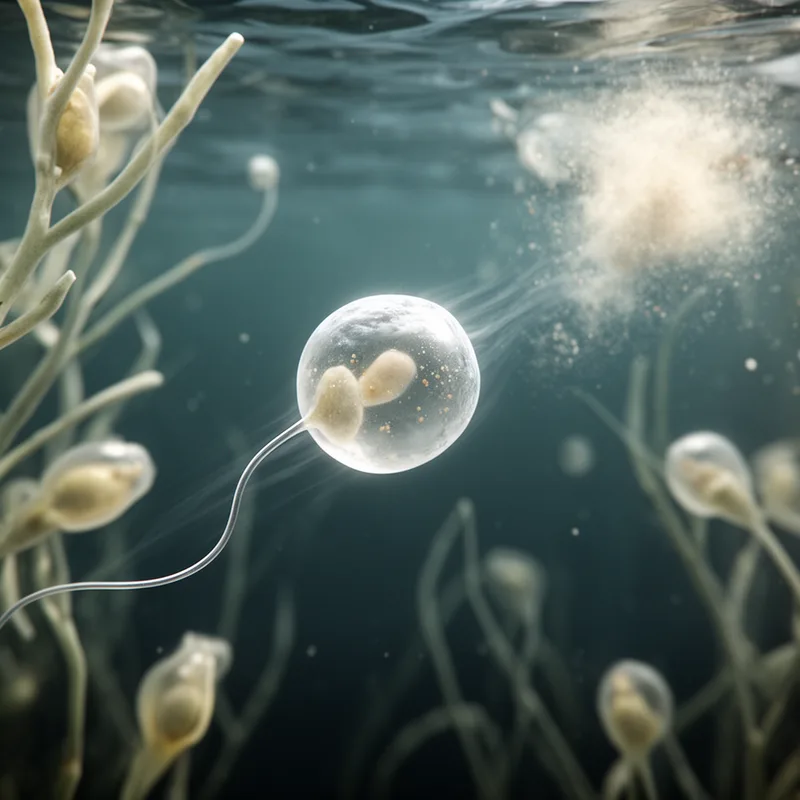
zoospore


 1
9.9
A spore that forms without sex in some algae and fungi and swims using a tail-like thread
- noun
- /ˈzuːəˌspɔːr/
- Specialized
:
zoóspora
- Scientists studied the movement of zo spores, noting how their flagella help them navigate through aquatic environments.
- vesicles with zoospores
Examples
-
Development of the different stages of vesicle and zoospore formation, cleavage, and release was assessed on colonized grass leaves in water cultures containing Ca++ and Mg++.
Academic text (2015) -
During the life cycle of certain algae, the zoospore is released to reproduce asexually.
-
If vesicles and zoospores developed, we removed the grass blade with 10 vesicles, using tweezers, and placed it on a glass slide.
Academic text (2015) -
The zoospore uses its flagella to swim through the water in search of a suitable substrate.
Surface Forms
Morphology
Etymology
The word zoospore joins zoo-, the same 'zoo' you know as a place for animals, and spore meaning 'seed' or 'tiny reproductive cell'. So, think of it as an 'animal seed' — a spore that can move using little tails to swim to a new home.