
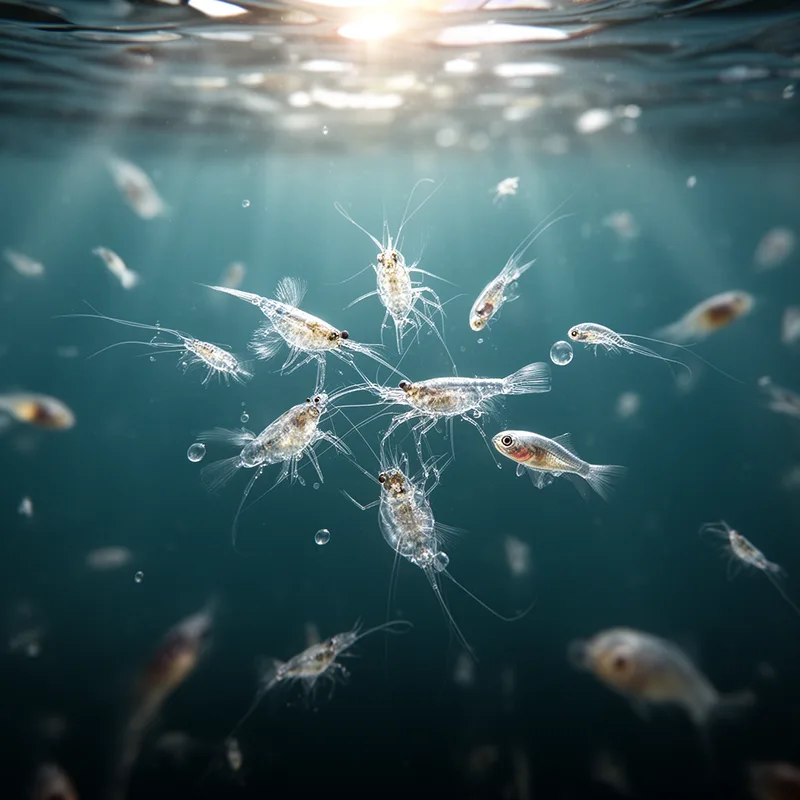
zooplankton
 1
7.4
1
7.4

- noun
- /ˈzuːoʊˌplæŋktən/
- Specialized
- During the summer, the abundance of zooplankton increases, attracting many fish species that depend on them.
- zooplankton abundance
- zooplankton population
- zooplankton richness
Loading YouTube…
Watch on YouTubeThe researchers say that this resembles effects which have been observed in bacteria cells and zooplanktons, but also insects, birds and fish.
- The researchers say that this resembles effects which have been observed in bacteria cells and zooplanktons, but also insects, birds and fish.
Examples
-
Many of the freshwater and marine zooplankton are nearly transparent.
Academic text (2010) -
Finally, marine animals like zooplankton, the grazers of the seas, may be involved.
Academic text (2003) -
Imagine the zooplankton rising and falling as the planet turns.
-
The flooded areas soon contain large numbers of larval and juvenile fish, which feed primarily on zooplankton.
Academic text (2009) -
The embryos hatch within a few days and become larvae, which feed on the abundant zooplankton.
Academic text (2009) -
His research examines the feeding behavior of freshwater zooplankton and their interactions with blue-green algae.
Academic text (1995) -
The decline of the cod stock has increased the zooplankton-eating Atlantic herring population, perhaps further increasing phytoplankton biomass.
Academic text (2006) -
In the ocean, small animals called zooplankton drift through the water, providing food for larger fish.
-
Scientists study the behavior of zooplankton to understand their role in aquatic ecosystems.
Surface Forms
Morphology
Etymology
Zooplankton joins zoo- ('animal'), the same start as zoo, and plankton ('drifter'). So, it means small animals that drift in water.