

zoonosis
 1
7.1

- noun
- /zuˈoʊnəsɪs/
- Specialized
- It will be a zoonosis—an animal infection that spills over into humans.
- emerging zoonosis
- zoonosis caused
Examples
-
And influenza, notes Olsen, is a zoonosis that comes from birds.
Academic text (2008) -
Brucellosis is a highly contagious zoonosis caused by ingestion of unsterilized milk or meat from infected cows or close contact with their secretions.
Academic text (2012) -
Rift Valley fever (RVF) is an emerging zoonosis posing a public health threat to humans in Africa.
Academic text (2013) -
Anthrax, a zoonosis caused by the bacterium Bacillus anthracis, is associated with rural areas or agricultural production (1-3).
Academic text (2014) -
Q fever is an occupational zoonosis caused by Coxiella burnetii, a gram-negative bacterium (1).
Academic text (2014) -
A zoonosis can be transmitted to humans through contact with infected animals or their waste.
-
Researchers study zoonosis to understand how diseases spread from wildlife to the human population.
-
Preventing zoonosis is crucial for protecting public health, especially in areas with high interaction between humans and animals.
Synonyms
 1
4.8
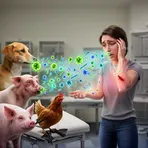
A disease that animals give to people
Surface Forms
Morphology
zoonosis = zoon (semi-transparent) = zoon + osis
Formed from the scientific combining form 'zoon-' (animal) plus medical suffix '-osis' (disease); the parts are technical/Greek and may be unfamiliar to average learners, so the connection is only partly transparent.
Etymology
Zoonosis comes from the Greek zoon 'animal' and the ending -osis 'disease'. So a zoonosis is a disease that comes from animals and can be passed to people, and a helpful way to remember it is to think of zoo, a place with animals.