
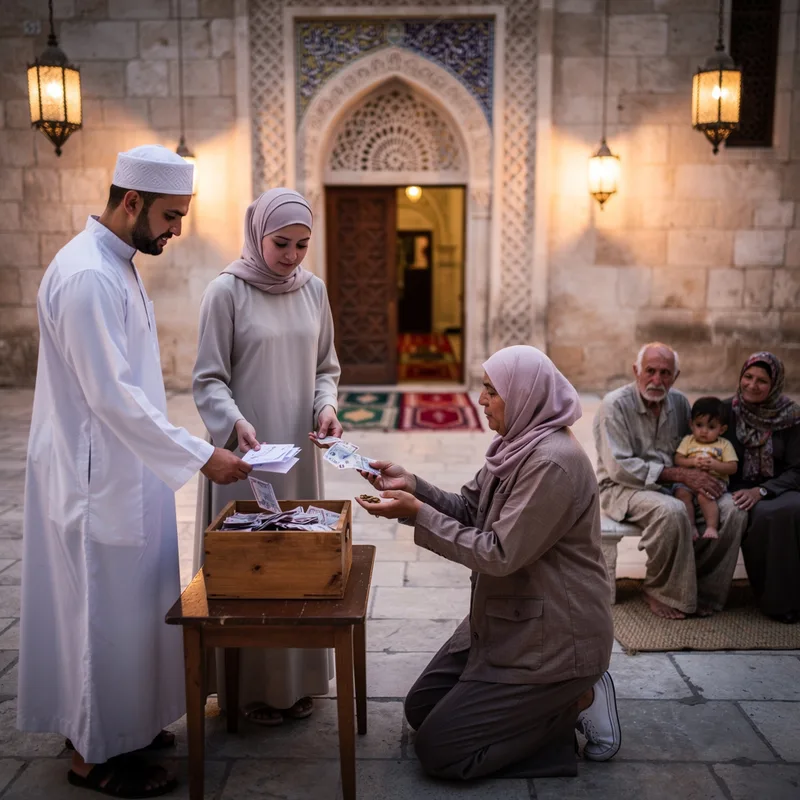
zakat
 3
9.5
3
9.5

- noun
- /zəˈkɑt/
- Specialized
- This activity is usually justified by reference to the religious duty of paying zakat (the Islamic alms tax).
- zakat and charity
- pay the zakat
Examples
-
Since charity, or zakat, is one of the five pillars of Islam, governments are worried that they will be portrayed as anti-Islamic.
Academic text (2008) -
Through the mosque, Muslims pray, congregate for the khutba, collect and distribute zakat (religious charity), listen to religious lessons, and receive fatwas (religious legal rulings).
Academic text (1999) -
Zakat is the Islamic principle of giving a portion of your money to the poor.
Blog text (3) -
this is the holy practice of Zakat, one of the five pillars of Islam.
-
No income tax is assessed on Saudi nationals, although as Muslims they are obligated to pay the zakat.
Academic text (2003) -
The establishment and functioning of the clinics also rely heavily on donations from the community and on zakat (an Islamic form of tithe) from the mosque.
Academic text (1995) -
Malek Bennabi believes that the Zakat (the giving of mandatory alms) is a good example of Islam's social legislation posited by the Qur'an.
Academic text (1996) -
The three mechanisms that distribute wealth are zakat, an almsgiving requirement that is one of the five core pillars of Islam; saddaqah, an optional charitable action; and waqf, the donation of an asset such as property, or a major gift, designed to support long-term solutions.
Academic text (2007) -
As a devoted Muslim, she ensures that she pays her zakat each year to assist those in need.
-
Giving zakat is a crucial element of Islamic faith and helps support the less fortunate.
Surface Forms
Etymology
Zakat comes from the Arabic root zakā, which means 'to be pure' and 'to grow'. So paying zakat is giving a set part of your wealth to help the poor and to 'purify' your money, which is why it is a required act of charity in Islam.