
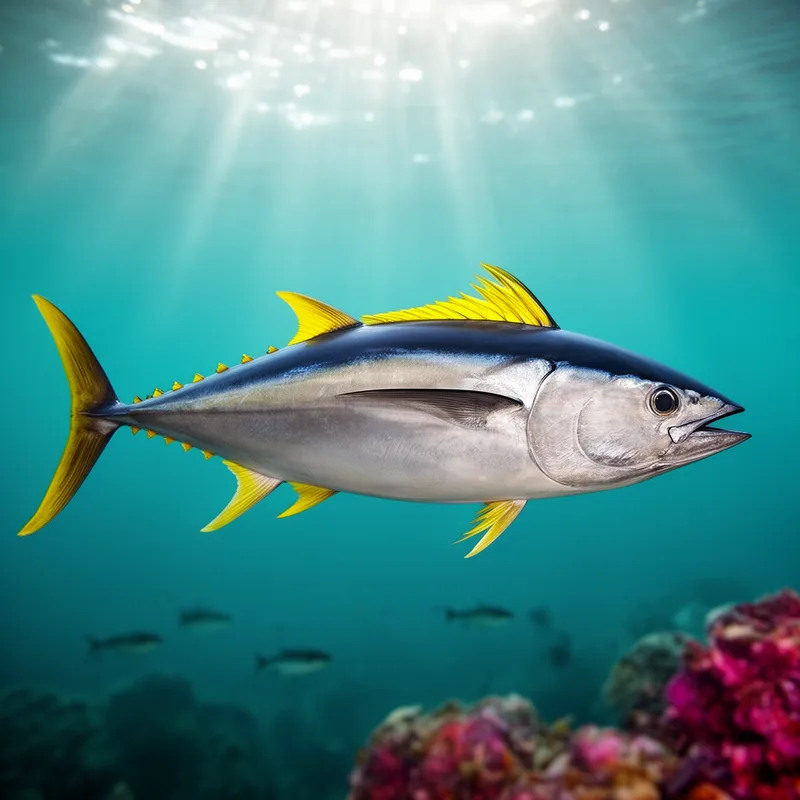
yellowfin tuna
 2
3.8
2
3.8

- noun
- /ˈjɛloʊfɪn ˈtuːnə/
- Yellowfin tuna was second in importance at 16,100 t, or 13% of the total catch.
- yellowfin tuna catch
- yellowfin tuna fishery
- availability of yellowfin tuna
Examples
-
Of the approximately 100 Australian boats engaged in the fishery, 50% reported catching only yellowfin tuna.
Academic text (1995) -
The decline was 40% for yellowfin tuna and 48% for skipjack tuna from the 1991 catch rates.
Academic text (1997) -
The Australian vessels primarily harvest yellowfin tuna.
Academic text (1995) -
About 40 percent of the yellowfin tuna caught in the Indian Ocean come from the Seychelles' EEZ.
Academic text (1990) -
The results indicate that patrolling the longline in the southern fishery increases yellowfin tuna catch by 16%, holding all other factors constant.
Academic text (1995) -
Sampling by NMFS personnel was, therefore, established for accurately determining the species composition in the "yellowfin tuna" landings.
Academic text (1997) -
In 1996, canneries in Page began, for the first time, to separate bigeye tuna from yellowfin tuna and record their landings separately.
Academic text (1997) -
The lack of a cannery market is especially troublesome during the summer when the skipjack and yellowfin tuna fisheries reach peak production.
Academic text (1993) -
The western Pacific fishery, however, is dominated by skipjack tuna catches, whereas the other fisheries are dominated by yellowfin tuna catches.
Academic text (1997) -
The most common variety available in the Colorado market is yellowfin tuna.
Synonyms
 213
1.0
213
1.0
A large, fast sea fish often eaten fresh or canned
 24
1.0
24
1.0
A large sea fish that people often eat fresh, grilled or canned
 4
6.2
4
6.2
A large tuna with yellow fins that lives in warm oceans
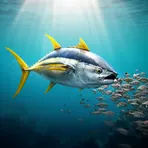
A large fast tuna that eats smaller fish and lives in warm oceans
Surface Forms
Morphology
This is a straightforward descriptive compound: 'yellowfin' (a tuna with yellow fins) combined with 'tuna' denotes a specific kind of tuna. The species meaning is directly predictable from the constituent meanings and follows common compounding patterns across languages, so a B1 learner who knows the parts will understand it.
Etymology
Yellowfin tuna comes from the fish's bright yellow fins, which are easy to see near the water. Fishermen and cooks used that clear picture as the name, so today the phrase means the large tuna with yellow fins.